Looking for cool math games for arithmetic practice? This guide focuses on number sprint multiplication in our own local Number Sprint. This site is independent of the official Coolmath Games website; its ten-question game is a separate implementation.
A multiplication fact can be understood as equal groups. Breaking one factor into convenient parts keeps that structure visible instead of turning a larger fact into a blind guess.
A practical starting point
The worked exercises use factors from one to twelve, matching the range in the local Number Sprint code. They show partial products and a separate check, without a claim that one method is fastest for every learner.
Preserve the equal groups
When you split a factor into two parts, multiply each part by the same other factor, then add the partial products. For example, a split into five groups and two groups still represents seven groups overall. Check that no group disappeared or was counted twice. The exercises show exact decompositions rather than claiming that one route is fastest for everybody. Understanding an already familiar fact can make the structure easier to reuse on a less familiar one.
A mistake to watch for
Do not lose a group when splitting a factor. If you replace seven groups by five groups and two groups, both parts must be multiplied by the same group size before adding.
Worked examples and practice decisions
Try each question before reading its explanation. These examples are deliberately limited to the information they state. They separate a rule or calculation from a broader judgement about a complete game.
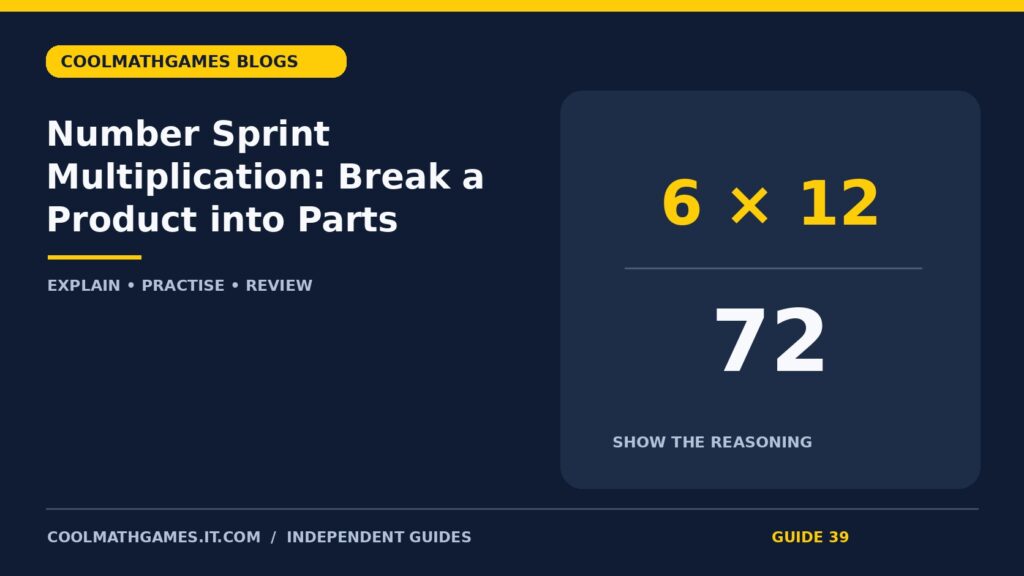
1. Calculation 1: 6 × 12
The exercise is 6 × 12. Work it out before reading the answer. These numbers sit within the operand range used by our local Number Sprint, but this is a written exercise rather than a question captured from a live round.
The answer is 72. Split 6 groups into 5 groups and 1 groups. The partial products are 5 × 12 = 60 and 1 × 12 = 12. Adding them gives 72. Both parts use the same group size. Check the group count: 5 + 1 = 6. The product also equals 12 groups of 6. This second description can help reveal a missing group, although either method still needs accurate arithmetic.
For an independent representation, show 6 and 12 using counters, equal groups or a number line appropriate to the operation. Explain why that representation gives 72. Then change one operand by one and predict how the answer changes before recalculating. Your explanation should identify the operation, not just repeat the final answer.
2. Calculation 2: 12 × 9
The exercise is 12 × 9. Work it out before reading the answer. These numbers sit within the operand range used by our local Number Sprint, but this is a written exercise rather than a question captured from a live round.
The answer is 108. Split 12 groups into 5 groups and 7 groups. The partial products are 5 × 9 = 45 and 7 × 9 = 63. Adding them gives 108. Both parts use the same group size. Check the group count: 5 + 7 = 12. The product also equals 9 groups of 12. This second description can help reveal a missing group, although either method still needs accurate arithmetic.
For an independent representation, show 12 and 9 using counters, equal groups or a number line appropriate to the operation. Explain why that representation gives 108. Then change one operand by one and predict how the answer changes before recalculating. Your explanation should identify the operation, not just repeat the final answer.
3. Calculation 3: 8 × 4
The exercise is 8 × 4. Work it out before reading the answer. These numbers sit within the operand range used by our local Number Sprint, but this is a written exercise rather than a question captured from a live round.
The answer is 32. Split 8 groups into 5 groups and 3 groups. The partial products are 5 × 4 = 20 and 3 × 4 = 12. Adding them gives 32. Both parts use the same group size. Check the group count: 5 + 3 = 8. The product also equals 4 groups of 8. This second description can help reveal a missing group, although either method still needs accurate arithmetic.
For an independent representation, show 8 and 4 using counters, equal groups or a number line appropriate to the operation. Explain why that representation gives 32. Then change one operand by one and predict how the answer changes before recalculating. Your explanation should identify the operation, not just repeat the final answer.
4. Calculation 4: 10 × 3
The exercise is 10 × 3. Work it out before reading the answer. These numbers sit within the operand range used by our local Number Sprint, but this is a written exercise rather than a question captured from a live round.
The answer is 30. Split 10 groups into 5 groups and 5 groups. The partial products are 5 × 3 = 15 and 5 × 3 = 15. Adding them gives 30. Both parts use the same group size. Check the group count: 5 + 5 = 10. The product also equals 3 groups of 10. This second description can help reveal a missing group, although either method still needs accurate arithmetic.
For an independent representation, show 10 and 3 using counters, equal groups or a number line appropriate to the operation. Explain why that representation gives 30. Then change one operand by one and predict how the answer changes before recalculating. Your explanation should identify the operation, not just repeat the final answer.
5. Calculation 5: 9 × 12
The exercise is 9 × 12. Work it out before reading the answer. These numbers sit within the operand range used by our local Number Sprint, but this is a written exercise rather than a question captured from a live round.
The answer is 108. Split 9 groups into 5 groups and 4 groups. The partial products are 5 × 12 = 60 and 4 × 12 = 48. Adding them gives 108. Both parts use the same group size. Check the group count: 5 + 4 = 9. The product also equals 12 groups of 9. This second description can help reveal a missing group, although either method still needs accurate arithmetic.
For an independent representation, show 9 and 12 using counters, equal groups or a number line appropriate to the operation. Explain why that representation gives 108. Then change one operand by one and predict how the answer changes before recalculating. Your explanation should identify the operation, not just repeat the final answer.
6. Calculation 6: 3 × 9
The exercise is 3 × 9. Work it out before reading the answer. These numbers sit within the operand range used by our local Number Sprint, but this is a written exercise rather than a question captured from a live round.
The answer is 27. Split 3 groups into 2 groups and 1 groups. The partial products are 2 × 9 = 18 and 1 × 9 = 9. Adding them gives 27. Both parts use the same group size. Check the group count: 2 + 1 = 3. The product also equals 9 groups of 3. This second description can help reveal a missing group, although either method still needs accurate arithmetic.
For an independent representation, show 3 and 9 using counters, equal groups or a number line appropriate to the operation. Explain why that representation gives 27. Then change one operand by one and predict how the answer changes before recalculating. Your explanation should identify the operation, not just repeat the final answer.
7. Calculation 7: 5 × 9
The exercise is 5 × 9. Work it out before reading the answer. These numbers sit within the operand range used by our local Number Sprint, but this is a written exercise rather than a question captured from a live round.
The answer is 45. Split 5 groups into 4 groups and 1 groups. The partial products are 4 × 9 = 36 and 1 × 9 = 9. Adding them gives 45. Both parts use the same group size. Check the group count: 4 + 1 = 5. The product also equals 9 groups of 5. This second description can help reveal a missing group, although either method still needs accurate arithmetic.
For an independent representation, show 5 and 9 using counters, equal groups or a number line appropriate to the operation. Explain why that representation gives 45. Then change one operand by one and predict how the answer changes before recalculating. Your explanation should identify the operation, not just repeat the final answer.
8. Calculation 8: 3 × 11
The exercise is 3 × 11. Work it out before reading the answer. These numbers sit within the operand range used by our local Number Sprint, but this is a written exercise rather than a question captured from a live round.
The answer is 33. Split 3 groups into 2 groups and 1 groups. The partial products are 2 × 11 = 22 and 1 × 11 = 11. Adding them gives 33. Both parts use the same group size. Check the group count: 2 + 1 = 3. The product also equals 11 groups of 3. This second description can help reveal a missing group, although either method still needs accurate arithmetic.
For an independent representation, show 3 and 11 using counters, equal groups or a number line appropriate to the operation. Explain why that representation gives 33. Then change one operand by one and predict how the answer changes before recalculating. Your explanation should identify the operation, not just repeat the final answer.
9. Calculation 9: 5 × 5
The exercise is 5 × 5. Work it out before reading the answer. These numbers sit within the operand range used by our local Number Sprint, but this is a written exercise rather than a question captured from a live round.
The answer is 25. Split 5 groups into 4 groups and 1 groups. The partial products are 4 × 5 = 20 and 1 × 5 = 5. Adding them gives 25. Both parts use the same group size. Check the group count: 4 + 1 = 5. The product also equals 5 groups of 5. This second description can help reveal a missing group, although either method still needs accurate arithmetic.
For an independent representation, show 5 and 5 using counters, equal groups or a number line appropriate to the operation. Explain why that representation gives 25. Then change one operand by one and predict how the answer changes before recalculating. Your explanation should identify the operation, not just repeat the final answer.
10. Calculation 10: 7 × 1
The exercise is 7 × 1. Work it out before reading the answer. These numbers sit within the operand range used by our local Number Sprint, but this is a written exercise rather than a question captured from a live round.
The answer is 7. Split 7 groups into 5 groups and 2 groups. The partial products are 5 × 1 = 5 and 2 × 1 = 2. Adding them gives 7. Both parts use the same group size. Check the group count: 5 + 2 = 7. The product also equals 1 groups of 7. This second description can help reveal a missing group, although either method still needs accurate arithmetic.
For an independent representation, show 7 and 1 using counters, equal groups or a number line appropriate to the operation. Explain why that representation gives 7. Then change one operand by one and predict how the answer changes before recalculating. Your explanation should identify the operation, not just repeat the final answer.
Use the guide in your next session
Try a calculation you already know so that you can focus on explaining the method. Then use the same structure on a less familiar fact and compare the intermediate results.
Begin with one observation connected to number sprint multiplication. After checking an example, close the answer and reconstruct the reasoning in your own words. If a step is uncertain, return to that step rather than repeating a result you cannot explain. A small, specific correction provides a clearer next aim than trying to improve every part of a game at once.
Frequently asked questions
Is Number Sprint a timed test?
The local implementation has ten questions and no countdown. Its name should not be interpreted as a claim that every learner must rush.
Which operands do these exercises use?
They use whole-number operands from one to twelve, matching the local code. Subtraction is arranged to avoid negative results.
Does one score measure general maths ability?
No. A short random round describes those answers. Review the particular operation, method and calculation instead of making a broad assessment.
More cool math games guides
- Number Sprint Addition: Make Ten and Check the Sum
- Number Sprint Subtraction: Find the Difference Clearly
- Open the relevant game or guide page
Sources and scope
This is an independent, AI-assisted editorial guide. The worked examples and diagrams are original teaching material, not official game screenshots or a claim of personal live-game testing. Game interfaces can change; check the current instructions when controls or rules differ.