If you are learning chess on Cool Math Games, this independent guide helps you work on chess position review. The examples use orthodox chess rules and reproducible positions; they are not best-move engine recommendations.
A useful review does not need to begin with an engine score. You can start by identifying the side to move, whether the king is in check and which legal choices the position allows.
A practical starting point
Separate observations from conclusions. A piece attacks a square: that is an observation you can check. A move wins the game: that is a stronger conclusion that requires a continuation.
Check is a constraint, not a result by itself
When a side is in check, its next move must remove that check legally. Possible responses depend on the position: moving the king, taking the attacker or blocking a line may be available. Checkmate means the king is in check with no legal answer. Stalemate means there is no legal move while the king is not in check. The king is not captured in orthodox chess. Use the complete board to distinguish those outcomes before giving a position a dramatic label.
A mistake to watch for
Do not turn a legal illustrative sequence into a recommended opening. The examples were selected for discussion, not as proof of optimal play. Their value is in the questions you ask at each position.
Worked examples and practice decisions
Try each question before reading its explanation. These examples are deliberately limited to the information they state. They separate a rule or calculation from a broader judgement about a complete game.
1. Legal move record 1: c3
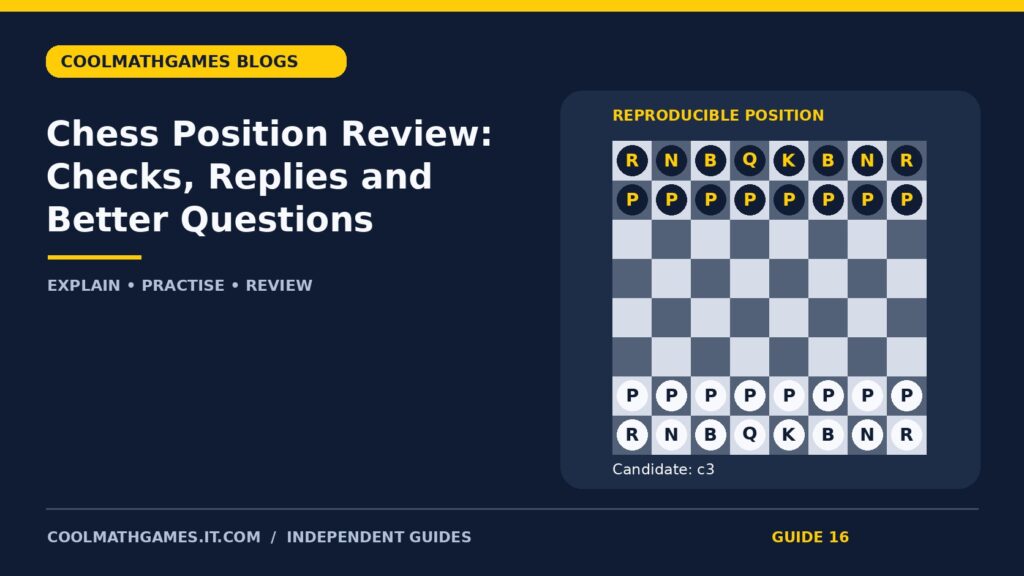
Set up the full position using this FEN record: rnbqkbnr/pppppppp/8/8/8/8/PPPPPPPP/RNBQKBNR w KQkq - 0 1. It contains the board arrangement, side to move and special-rights information needed to reproduce the example. FEN is a position description, not an instruction to paste data into an unfamiliar website.
The illustrative legal move is c3: White’s pawn goes from c2 to c3. The side to move was not in check before the move. The captured piece is none. Afterwards, the next side is not in check and has 20 legal replies in this exact position.
A different legal candidate is Nh3. Set it up from the original position, rather than from the board after the first move. Compare which squares and lines change. Both moves being legal does not make them equally strong; a stronger claim would require a separate analysis of the position and the replies.
2. Legal move record 2: b5
Set up the full position using this FEN record: rnbqkbnr/pppppppp/8/8/8/2P5/PP1PPPPP/RNBQKBNR b KQkq - 0 1. It contains the board arrangement, side to move and special-rights information needed to reproduce the example. FEN is a position description, not an instruction to paste data into an unfamiliar website.
The illustrative legal move is b5: Black’s pawn goes from b7 to b5. The side to move was not in check before the move. The captured piece is none. Afterwards, the next side is not in check and has 21 legal replies in this exact position.
A different legal candidate is Nf6. Set it up from the original position, rather than from the board after the first move. Compare which squares and lines change. Both moves being legal does not make them equally strong; a stronger claim would require a separate analysis of the position and the replies.
3. Legal move record 3: d3
Set up the full position using this FEN record: rnbqkbnr/p1pppppp/8/1p6/8/2P5/PP1PPPPP/RNBQKBNR w KQkq - 0 2. It contains the board arrangement, side to move and special-rights information needed to reproduce the example. FEN is a position description, not an instruction to paste data into an unfamiliar website.
The illustrative legal move is d3: White’s pawn goes from d2 to d3. The side to move was not in check before the move. The captured piece is none. Afterwards, the next side is not in check and has 21 legal replies in this exact position.
A different legal candidate is Qa4. Set it up from the original position, rather than from the board after the first move. Compare which squares and lines change. Both moves being legal does not make them equally strong; a stronger claim would require a separate analysis of the position and the replies.
4. Legal move record 4: h5
Set up the full position using this FEN record: rnbqkbnr/p1pppppp/8/1p6/8/2PP4/PP2PPPP/RNBQKBNR b KQkq - 0 2. It contains the board arrangement, side to move and special-rights information needed to reproduce the example. FEN is a position description, not an instruction to paste data into an unfamiliar website.
The illustrative legal move is h5: Black’s pawn goes from h7 to h5. The side to move was not in check before the move. The captured piece is none. Afterwards, the next side is not in check and has 28 legal replies in this exact position.
A different legal candidate is Ba6. Set it up from the original position, rather than from the board after the first move. Compare which squares and lines change. Both moves being legal does not make them equally strong; a stronger claim would require a separate analysis of the position and the replies.
5. Legal move record 5: f4
Set up the full position using this FEN record: rnbqkbnr/p1ppppp1/8/1p5p/8/2PP4/PP2PPPP/RNBQKBNR w KQkq - 0 3. It contains the board arrangement, side to move and special-rights information needed to reproduce the example. FEN is a position description, not an instruction to paste data into an unfamiliar website.
The illustrative legal move is f4: White’s pawn goes from f2 to f4. The side to move was not in check before the move. The captured piece is none. Afterwards, the next side is not in check and has 22 legal replies in this exact position.
A different legal candidate is Qb3. Set it up from the original position, rather than from the board after the first move. Compare which squares and lines change. Both moves being legal does not make them equally strong; a stronger claim would require a separate analysis of the position and the replies.
6. Legal move record 6: a6
Set up the full position using this FEN record: rnbqkbnr/p1ppppp1/8/1p5p/5P2/2PP4/PP2P1PP/RNBQKBNR b KQkq - 0 3. It contains the board arrangement, side to move and special-rights information needed to reproduce the example. FEN is a position description, not an instruction to paste data into an unfamiliar website.
The illustrative legal move is a6: Black’s pawn goes from a7 to a6. The side to move was not in check before the move. The captured piece is none. Afterwards, the next side is not in check and has 25 legal replies in this exact position.
A different legal candidate is Ba6. Set it up from the original position, rather than from the board after the first move. Compare which squares and lines change. Both moves being legal does not make them equally strong; a stronger claim would require a separate analysis of the position and the replies.
7. Legal move record 7: Nd2
Set up the full position using this FEN record: rnbqkbnr/2ppppp1/p7/1p5p/5P2/2PP4/PP2P1PP/RNBQKBNR w KQkq - 0 4. It contains the board arrangement, side to move and special-rights information needed to reproduce the example. FEN is a position description, not an instruction to paste data into an unfamiliar website.
The illustrative legal move is Nd2: White’s knight goes from b1 to d2. The side to move was not in check before the move. The captured piece is none. Afterwards, the next side is not in check and has 20 legal replies in this exact position.
A different legal candidate is Qd2. Set it up from the original position, rather than from the board after the first move. Compare which squares and lines change. Both moves being legal does not make them equally strong; a stronger claim would require a separate analysis of the position and the replies.
8. Legal move record 8: f6
Set up the full position using this FEN record: rnbqkbnr/2ppppp1/p7/1p5p/5P2/2PP4/PP1NP1PP/R1BQKBNR b KQkq - 1 4. It contains the board arrangement, side to move and special-rights information needed to reproduce the example. FEN is a position description, not an instruction to paste data into an unfamiliar website.
The illustrative legal move is f6: Black’s pawn goes from f7 to f6. The side to move was not in check before the move. The captured piece is none. Afterwards, the next side is not in check and has 25 legal replies in this exact position.
A different legal candidate is g6. Set it up from the original position, rather than from the board after the first move. Compare which squares and lines change. Both moves being legal does not make them equally strong; a stronger claim would require a separate analysis of the position and the replies.
9. Legal move record 9: f5
Set up the full position using this FEN record: rnbqkbnr/2ppp1p1/p4p2/1p5p/5P2/2PP4/PP1NP1PP/R1BQKBNR w KQkq - 0 5. It contains the board arrangement, side to move and special-rights information needed to reproduce the example. FEN is a position description, not an instruction to paste data into an unfamiliar website.
The illustrative legal move is f5: White’s pawn goes from f4 to f5. The side to move was not in check before the move. The captured piece is none. Afterwards, the next side is not in check and has 18 legal replies in this exact position.
A different legal candidate is Qa4. Set it up from the original position, rather than from the board after the first move. Compare which squares and lines change. Both moves being legal does not make them equally strong; a stronger claim would require a separate analysis of the position and the replies.
10. Legal move record 10: e6
Set up the full position using this FEN record: rnbqkbnr/2ppp1p1/p4p2/1p3P1p/8/2PP4/PP1NP1PP/R1BQKBNR b KQkq - 0 5. It contains the board arrangement, side to move and special-rights information needed to reproduce the example. FEN is a position description, not an instruction to paste data into an unfamiliar website.
The illustrative legal move is e6: Black’s pawn goes from e7 to e6. The side to move was not in check before the move. The captured piece is none. Afterwards, the next side is not in check and has 25 legal replies in this exact position.
A different legal candidate is c6. Set it up from the original position, rather than from the board after the first move. Compare which squares and lines change. Both moves being legal does not make them equally strong; a stronger claim would require a separate analysis of the position and the replies.
Use the guide in your next session
After a game, choose one position that puzzled you. Describe the threat in plain language and identify which replies you considered. This creates a specific question for deeper analysis.
Begin with one observation connected to chess position review. After checking an example, close the answer and reconstruct the reasoning in your own words. If a step is uncertain, return to that step rather than repeating a result you cannot explain. A small, specific correction provides a clearer next aim than trying to improve every part of a game at once.
Frequently asked questions
Are these engine recommendations?
No. They are legal move records checked with a rules library. No best-move evaluation is claimed.
Why include the full FEN?
FEN preserves the board, side to move and special-rights information needed to reproduce a position rather than describing an isolated piece.
Is the king captured to end the game?
No. Orthodox chess uses checkmate when the king is in check and there is no legal answer. Stalemate is a separate drawn condition.
More cool math games guides
- Chess Piece Movement: A Beginner Guide to Legal Choices
- Chess Opening Habits: Develop Pieces with a Clear Purpose
- Open the relevant game or guide page
Sources and scope
This is an independent, AI-assisted editorial guide. The worked examples and diagrams are original teaching material, not official game screenshots or a claim of personal live-game testing. Game interfaces can change; check the current instructions when controls or rules differ.