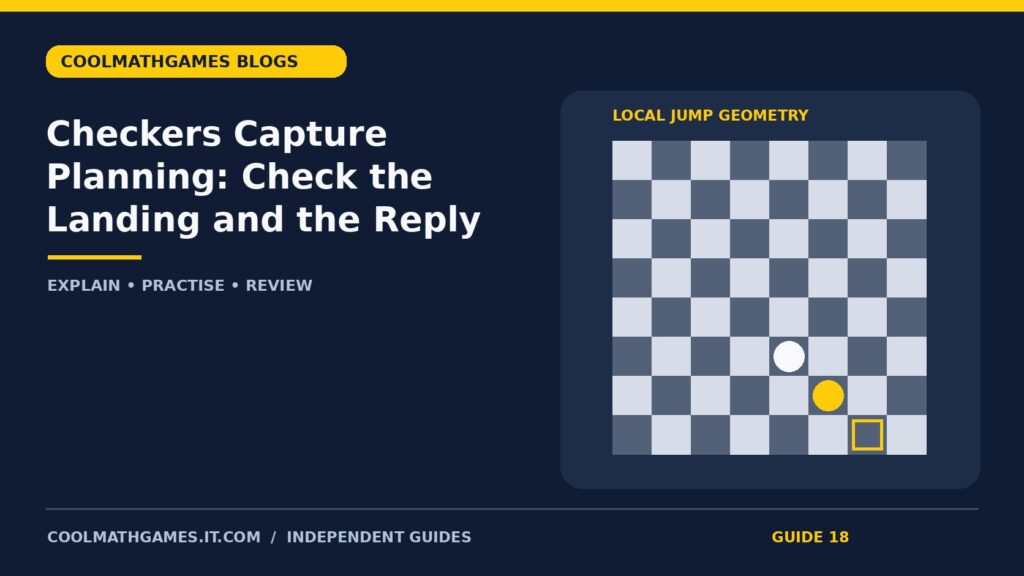
For readers practising checkers on Cool Math Games, this independent guide focuses on checkers capture planning. The exercises state their local movement model explicitly, so check your game’s variant before applying a pattern.
A capture can look attractive until you examine the square where your piece must finish. The destination matters because it shapes the opponent’s next choices.
A practical starting point
Read the entire local arrangement before choosing a jump. Note which piece is crossed, whether the landing is empty and whether another capture may become available. Do not stop the analysis at the first removed piece.
Locate the landing before counting a capture
A diagonal neighbour is not enough to establish a jump. The square beyond that opponent must be available under the rules being used. Mark the start, crossed square and landing separately. Then ask what the opponent could do next. This prevents a local geometry check from turning into an unsupported exchange evaluation. On a real board, another required capture or an occupied landing can change the decision. The examples isolate one jump so that those assumptions remain visible.
A mistake to watch for
These exercises use an explicitly defined local capture model. They do not impose the same compulsory-capture rule on every website or variant. Read your game’s rules before applying a pattern in play.
Worked examples and practice decisions
Try each question before reading its explanation. These examples are deliberately limited to the information they state. They separate a rule or calculation from a broader judgement about a complete game.
1. Diagonal exercise 1: identify the landing
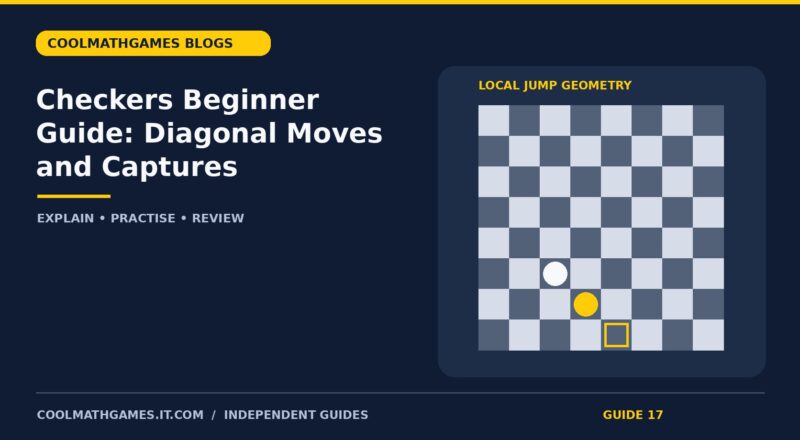
Use an eight-by-eight coordinate sketch. A ordinary man moving toward larger row numbers starts at row 6, column 5. An opposing piece occupies row 7, column 6. The square at row 8, column 7 is empty. No other local piece blocks the two-step diagonal.
The proposed jump goes toward larger row numbers and lands at row 8, column 7, removing the opposing piece it crosses. Each step changes the row and column by one, so the route stays on the same colour of square. After locating this landing, inspect what a reply could do. The example establishes one local capture, not the quality of a complete exchange. Other pieces on a real board may change which choice is sensible.
Countercheck: the stated landing is row 8, column 7. Imagine that square were occupied before the jump. The illustrated capture would no longer have the required empty destination. Now imagine removing the crossed opponent instead: that would also remove this particular jump. These changes show why the start, crossed piece and landing are three separate conditions.
2. Diagonal exercise 2: identify the landing
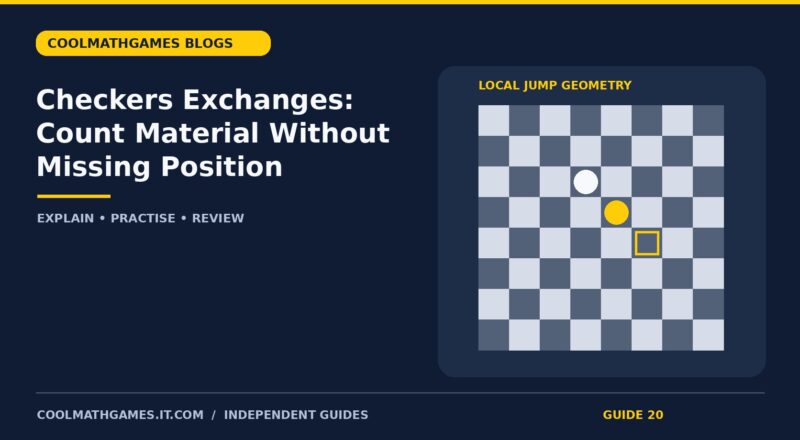
Use an eight-by-eight coordinate sketch. A ordinary man moving toward larger row numbers starts at row 3, column 4. An opposing piece occupies row 4, column 5. The square at row 5, column 6 is empty. No other local piece blocks the two-step diagonal.
The proposed jump goes toward larger row numbers and lands at row 5, column 6, removing the opposing piece it crosses. Each step changes the row and column by one, so the route stays on the same colour of square. After locating this landing, inspect what a reply could do. The example establishes one local capture, not the quality of a complete exchange. Other pieces on a real board may change which choice is sensible.
Countercheck: the stated landing is row 5, column 6. Imagine that square were occupied before the jump. The illustrated capture would no longer have the required empty destination. Now imagine removing the crossed opponent instead: that would also remove this particular jump. These changes show why the start, crossed piece and landing are three separate conditions.
3. Diagonal exercise 3: identify the landing
Use an eight-by-eight coordinate sketch. A ordinary man moving toward larger row numbers starts at row 3, column 6. An opposing piece occupies row 4, column 5. The square at row 5, column 4 is empty. No other local piece blocks the two-step diagonal.
The proposed jump goes toward larger row numbers and lands at row 5, column 4, removing the opposing piece it crosses. Each step changes the row and column by one, so the route stays on the same colour of square. After locating this landing, inspect what a reply could do. The example establishes one local capture, not the quality of a complete exchange. Other pieces on a real board may change which choice is sensible.
Countercheck: the stated landing is row 5, column 4. Imagine that square were occupied before the jump. The illustrated capture would no longer have the required empty destination. Now imagine removing the crossed opponent instead: that would also remove this particular jump. These changes show why the start, crossed piece and landing are three separate conditions.
4. Diagonal exercise 4: identify the landing
Use an eight-by-eight coordinate sketch. A ordinary man moving toward larger row numbers starts at row 3, column 4. An opposing piece occupies row 4, column 3. The square at row 5, column 2 is empty. No other local piece blocks the two-step diagonal.
The proposed jump goes toward larger row numbers and lands at row 5, column 2, removing the opposing piece it crosses. Each step changes the row and column by one, so the route stays on the same colour of square. After locating this landing, inspect what a reply could do. The example establishes one local capture, not the quality of a complete exchange. Other pieces on a real board may change which choice is sensible.
Countercheck: the stated landing is row 5, column 2. Imagine that square were occupied before the jump. The illustrated capture would no longer have the required empty destination. Now imagine removing the crossed opponent instead: that would also remove this particular jump. These changes show why the start, crossed piece and landing are three separate conditions.
5. Diagonal exercise 5: identify the landing
Use an eight-by-eight coordinate sketch. A ordinary man moving toward larger row numbers starts at row 4, column 3. An opposing piece occupies row 5, column 2. The square at row 6, column 1 is empty. No other local piece blocks the two-step diagonal.
The proposed jump goes toward larger row numbers and lands at row 6, column 1, removing the opposing piece it crosses. Each step changes the row and column by one, so the route stays on the same colour of square. After locating this landing, inspect what a reply could do. The example establishes one local capture, not the quality of a complete exchange. Other pieces on a real board may change which choice is sensible.
Countercheck: the stated landing is row 6, column 1. Imagine that square were occupied before the jump. The illustrated capture would no longer have the required empty destination. Now imagine removing the crossed opponent instead: that would also remove this particular jump. These changes show why the start, crossed piece and landing are three separate conditions.
6. Diagonal exercise 6: identify the landing
Use an eight-by-eight coordinate sketch. A ordinary man moving toward larger row numbers starts at row 6, column 3. An opposing piece occupies row 7, column 4. The square at row 8, column 5 is empty. No other local piece blocks the two-step diagonal.
The proposed jump goes toward larger row numbers and lands at row 8, column 5, removing the opposing piece it crosses. Each step changes the row and column by one, so the route stays on the same colour of square. After locating this landing, inspect what a reply could do. The example establishes one local capture, not the quality of a complete exchange. Other pieces on a real board may change which choice is sensible.
Countercheck: the stated landing is row 8, column 5. Imagine that square were occupied before the jump. The illustrated capture would no longer have the required empty destination. Now imagine removing the crossed opponent instead: that would also remove this particular jump. These changes show why the start, crossed piece and landing are three separate conditions.
7. Diagonal exercise 7: identify the landing
Use an eight-by-eight coordinate sketch. A ordinary man moving toward larger row numbers starts at row 5, column 6. An opposing piece occupies row 6, column 7. The square at row 7, column 8 is empty. No other local piece blocks the two-step diagonal.
The proposed jump goes toward larger row numbers and lands at row 7, column 8, removing the opposing piece it crosses. Each step changes the row and column by one, so the route stays on the same colour of square. After locating this landing, inspect what a reply could do. The example establishes one local capture, not the quality of a complete exchange. Other pieces on a real board may change which choice is sensible.
Countercheck: the stated landing is row 7, column 8. Imagine that square were occupied before the jump. The illustrated capture would no longer have the required empty destination. Now imagine removing the crossed opponent instead: that would also remove this particular jump. These changes show why the start, crossed piece and landing are three separate conditions.
8. Diagonal exercise 8: identify the landing
Use an eight-by-eight coordinate sketch. A ordinary man moving toward larger row numbers starts at row 4, column 3. An opposing piece occupies row 5, column 4. The square at row 6, column 5 is empty. No other local piece blocks the two-step diagonal.
The proposed jump goes toward larger row numbers and lands at row 6, column 5, removing the opposing piece it crosses. Each step changes the row and column by one, so the route stays on the same colour of square. After locating this landing, inspect what a reply could do. The example establishes one local capture, not the quality of a complete exchange. Other pieces on a real board may change which choice is sensible.
Countercheck: the stated landing is row 6, column 5. Imagine that square were occupied before the jump. The illustrated capture would no longer have the required empty destination. Now imagine removing the crossed opponent instead: that would also remove this particular jump. These changes show why the start, crossed piece and landing are three separate conditions.
9. Diagonal exercise 9: identify the landing
Use an eight-by-eight coordinate sketch. A ordinary man moving toward larger row numbers starts at row 5, column 6. An opposing piece occupies row 6, column 5. The square at row 7, column 4 is empty. No other local piece blocks the two-step diagonal.
The proposed jump goes toward larger row numbers and lands at row 7, column 4, removing the opposing piece it crosses. Each step changes the row and column by one, so the route stays on the same colour of square. After locating this landing, inspect what a reply could do. The example establishes one local capture, not the quality of a complete exchange. Other pieces on a real board may change which choice is sensible.
Countercheck: the stated landing is row 7, column 4. Imagine that square were occupied before the jump. The illustrated capture would no longer have the required empty destination. Now imagine removing the crossed opponent instead: that would also remove this particular jump. These changes show why the start, crossed piece and landing are three separate conditions.
Use the guide in your next session
Sketch the occupied squares and describe the route aloud. If you cannot name an empty landing, you have not yet established a legal jump. Keep the geometry clear before comparing possible exchanges.
Begin with one observation connected to checkers capture planning. After checking an example, close the answer and reconstruct the reasoning in your own words. If a step is uncertain, return to that step rather than repeating a result you cannot explain. A small, specific correction provides a clearer next aim than trying to improve every part of a game at once.
Frequently asked questions
Which checkers rules do the exercises assume?
They use an eight-by-eight local model with forward-moving ordinary men and short-range kings. Variant differences must be checked before live play.
Does an adjacent opponent always allow a jump?
The required landing beyond the opponent must be empty, and the move must satisfy the rules and other constraints of the full position.
Does a local capture prove that an exchange is good?
No. A reply, a promotion route or another available capture can change the evaluation.
More cool math games guides
- Checkers Beginner Guide: Diagonal Moves and Captures
- Checkers Kings: Practise Backward Diagonal Captures
- Open the relevant game or guide page
Sources and scope
This is an independent, AI-assisted editorial guide. The worked examples and diagrams are original teaching material, not official game screenshots or a claim of personal live-game testing. Game interfaces can change; check the current instructions when controls or rules differ.