For readers practising checkers on Cool Math Games, this independent guide focuses on checkers exchanges. The exercises state their local movement model explicitly, so check your game’s variant before applying a pattern.
An exchange is easier to discuss when you name exactly which pieces leave the board. A vague statement such as trading evenly can hide a different landing or a new threat.
A practical starting point
Track the local capture first. Then ask what the remaining position offers. A piece-count change is one observation, not a complete judgement about whether an exchange is good.
Keep a material ledger with a reply column
For one local jump, record the piece that moved, the opponent removed and the new location. A later reply may change the count again. Add that reply before calling a trade equal, favourable or unfavourable. Even an accurate count does not completely evaluate the resulting board: promotion routes, mobility and available captures matter too. The examples show immediate geometry and removal, giving you a precise first entry in a ledger without pretending to solve an undisplayed full exchange.
A mistake to watch for
Do not assign a fixed numerical value to every king or assume equal piece counts mean equal positions. Movement, access to promotion and legal replies all matter. The exercises isolate one capture so its mechanics stay visible.
Worked examples and practice decisions
Try each question before reading its explanation. These examples are deliberately limited to the information they state. They separate a rule or calculation from a broader judgement about a complete game.
1. Diagonal exercise 1: identify the landing
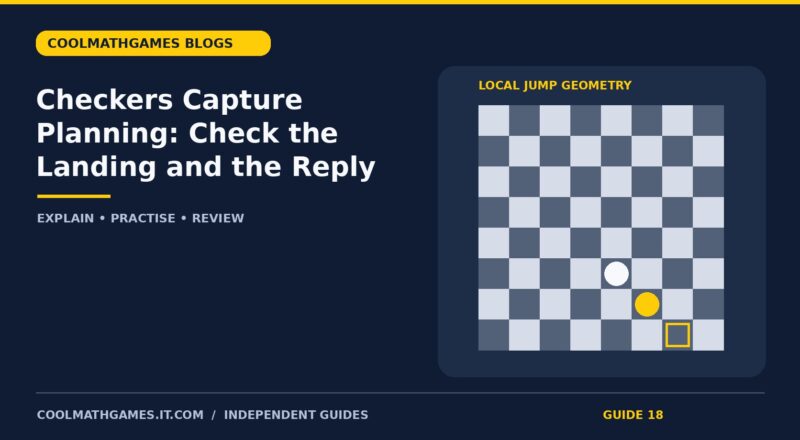
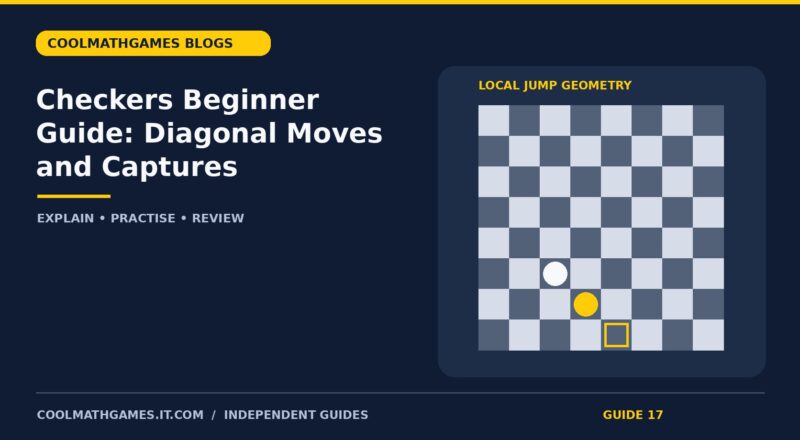
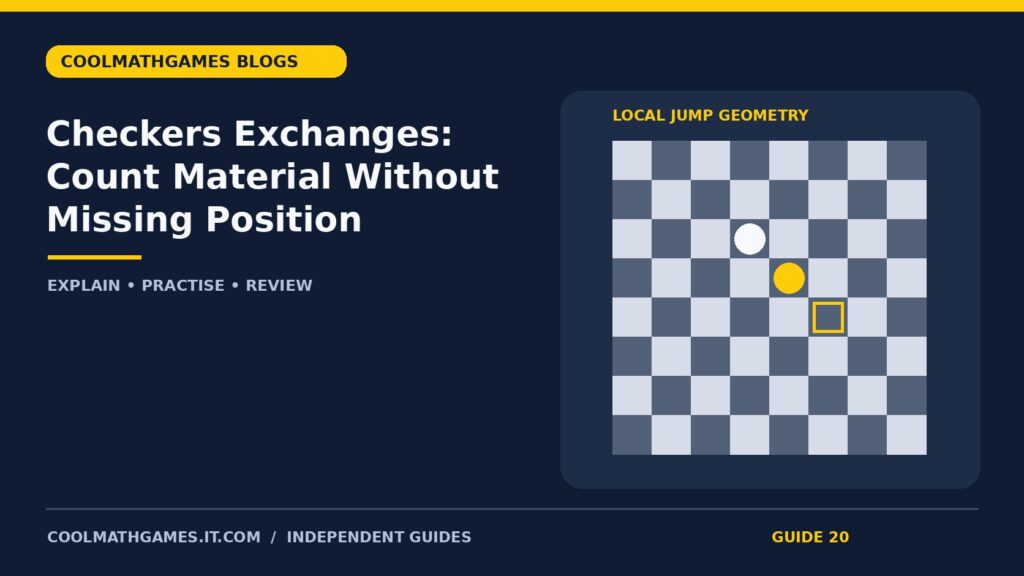
Use an eight-by-eight coordinate sketch. A ordinary man moving toward larger row numbers starts at row 3, column 4. An opposing piece occupies row 4, column 5. The square at row 5, column 6 is empty. No other local piece blocks the two-step diagonal.
The proposed jump goes toward larger row numbers and lands at row 5, column 6, removing the opposing piece it crosses. Each step changes the row and column by one, so the route stays on the same colour of square. The local count changes by one opposing piece and no friendly piece in this jump. A later recapture could change that comparison. Keep this immediate count separate from a claim that the whole exchange wins material.
Countercheck: the stated landing is row 5, column 6. Imagine that square were occupied before the jump. The illustrated capture would no longer have the required empty destination. Now imagine removing the crossed opponent instead: that would also remove this particular jump. These changes show why the start, crossed piece and landing are three separate conditions.
2. Diagonal exercise 2: identify the landing
Use an eight-by-eight coordinate sketch. A ordinary man moving toward larger row numbers starts at row 4, column 3. An opposing piece occupies row 5, column 2. The square at row 6, column 1 is empty. No other local piece blocks the two-step diagonal.
The proposed jump goes toward larger row numbers and lands at row 6, column 1, removing the opposing piece it crosses. Each step changes the row and column by one, so the route stays on the same colour of square. The local count changes by one opposing piece and no friendly piece in this jump. A later recapture could change that comparison. Keep this immediate count separate from a claim that the whole exchange wins material.
Countercheck: the stated landing is row 6, column 1. Imagine that square were occupied before the jump. The illustrated capture would no longer have the required empty destination. Now imagine removing the crossed opponent instead: that would also remove this particular jump. These changes show why the start, crossed piece and landing are three separate conditions.
3. Diagonal exercise 3: identify the landing
Use an eight-by-eight coordinate sketch. A ordinary man moving toward larger row numbers starts at row 6, column 5. An opposing piece occupies row 7, column 6. The square at row 8, column 7 is empty. No other local piece blocks the two-step diagonal.
The proposed jump goes toward larger row numbers and lands at row 8, column 7, removing the opposing piece it crosses. Each step changes the row and column by one, so the route stays on the same colour of square. The local count changes by one opposing piece and no friendly piece in this jump. A later recapture could change that comparison. Keep this immediate count separate from a claim that the whole exchange wins material.
Countercheck: the stated landing is row 8, column 7. Imagine that square were occupied before the jump. The illustrated capture would no longer have the required empty destination. Now imagine removing the crossed opponent instead: that would also remove this particular jump. These changes show why the start, crossed piece and landing are three separate conditions.
4. Diagonal exercise 4: identify the landing
Use an eight-by-eight coordinate sketch. A ordinary man moving toward larger row numbers starts at row 6, column 3. An opposing piece occupies row 7, column 4. The square at row 8, column 5 is empty. No other local piece blocks the two-step diagonal.
The proposed jump goes toward larger row numbers and lands at row 8, column 5, removing the opposing piece it crosses. Each step changes the row and column by one, so the route stays on the same colour of square. The local count changes by one opposing piece and no friendly piece in this jump. A later recapture could change that comparison. Keep this immediate count separate from a claim that the whole exchange wins material.
Countercheck: the stated landing is row 8, column 5. Imagine that square were occupied before the jump. The illustrated capture would no longer have the required empty destination. Now imagine removing the crossed opponent instead: that would also remove this particular jump. These changes show why the start, crossed piece and landing are three separate conditions.
5. Diagonal exercise 5: identify the landing
Use an eight-by-eight coordinate sketch. A ordinary man moving toward larger row numbers starts at row 5, column 4. An opposing piece occupies row 6, column 5. The square at row 7, column 6 is empty. No other local piece blocks the two-step diagonal.
The proposed jump goes toward larger row numbers and lands at row 7, column 6, removing the opposing piece it crosses. Each step changes the row and column by one, so the route stays on the same colour of square. The local count changes by one opposing piece and no friendly piece in this jump. A later recapture could change that comparison. Keep this immediate count separate from a claim that the whole exchange wins material.
Countercheck: the stated landing is row 7, column 6. Imagine that square were occupied before the jump. The illustrated capture would no longer have the required empty destination. Now imagine removing the crossed opponent instead: that would also remove this particular jump. These changes show why the start, crossed piece and landing are three separate conditions.
6. Diagonal exercise 6: identify the landing
Use an eight-by-eight coordinate sketch. A ordinary man moving toward larger row numbers starts at row 4, column 5. An opposing piece occupies row 5, column 6. The square at row 6, column 7 is empty. No other local piece blocks the two-step diagonal.
The proposed jump goes toward larger row numbers and lands at row 6, column 7, removing the opposing piece it crosses. Each step changes the row and column by one, so the route stays on the same colour of square. The local count changes by one opposing piece and no friendly piece in this jump. A later recapture could change that comparison. Keep this immediate count separate from a claim that the whole exchange wins material.
Countercheck: the stated landing is row 6, column 7. Imagine that square were occupied before the jump. The illustrated capture would no longer have the required empty destination. Now imagine removing the crossed opponent instead: that would also remove this particular jump. These changes show why the start, crossed piece and landing are three separate conditions.
7. Diagonal exercise 7: identify the landing
Use an eight-by-eight coordinate sketch. A ordinary man moving toward larger row numbers starts at row 3, column 6. An opposing piece occupies row 4, column 7. The square at row 5, column 8 is empty. No other local piece blocks the two-step diagonal.
The proposed jump goes toward larger row numbers and lands at row 5, column 8, removing the opposing piece it crosses. Each step changes the row and column by one, so the route stays on the same colour of square. The local count changes by one opposing piece and no friendly piece in this jump. A later recapture could change that comparison. Keep this immediate count separate from a claim that the whole exchange wins material.
Countercheck: the stated landing is row 5, column 8. Imagine that square were occupied before the jump. The illustrated capture would no longer have the required empty destination. Now imagine removing the crossed opponent instead: that would also remove this particular jump. These changes show why the start, crossed piece and landing are three separate conditions.
8. Diagonal exercise 8: identify the landing
Use an eight-by-eight coordinate sketch. A ordinary man moving toward larger row numbers starts at row 3, column 6. An opposing piece occupies row 4, column 5. The square at row 5, column 4 is empty. No other local piece blocks the two-step diagonal.
The proposed jump goes toward larger row numbers and lands at row 5, column 4, removing the opposing piece it crosses. Each step changes the row and column by one, so the route stays on the same colour of square. The local count changes by one opposing piece and no friendly piece in this jump. A later recapture could change that comparison. Keep this immediate count separate from a claim that the whole exchange wins material.
Countercheck: the stated landing is row 5, column 4. Imagine that square were occupied before the jump. The illustrated capture would no longer have the required empty destination. Now imagine removing the crossed opponent instead: that would also remove this particular jump. These changes show why the start, crossed piece and landing are three separate conditions.
9. Diagonal exercise 9: identify the landing
Use an eight-by-eight coordinate sketch. A ordinary man moving toward larger row numbers starts at row 4, column 3. An opposing piece occupies row 5, column 4. The square at row 6, column 5 is empty. No other local piece blocks the two-step diagonal.
The proposed jump goes toward larger row numbers and lands at row 6, column 5, removing the opposing piece it crosses. Each step changes the row and column by one, so the route stays on the same colour of square. The local count changes by one opposing piece and no friendly piece in this jump. A later recapture could change that comparison. Keep this immediate count separate from a claim that the whole exchange wins material.
Countercheck: the stated landing is row 6, column 5. Imagine that square were occupied before the jump. The illustrated capture would no longer have the required empty destination. Now imagine removing the crossed opponent instead: that would also remove this particular jump. These changes show why the start, crossed piece and landing are three separate conditions.
Use the guide in your next session
Record the mover, captured piece and landing. After checking that record, add one question about the next reply. This keeps material counting connected to the position instead of treating it as a separate score.
Begin with one observation connected to checkers exchanges. After checking an example, close the answer and reconstruct the reasoning in your own words. If a step is uncertain, return to that step rather than repeating a result you cannot explain. A small, specific correction provides a clearer next aim than trying to improve every part of a game at once.
Frequently asked questions
Which checkers rules do the exercises assume?
They use an eight-by-eight local model with forward-moving ordinary men and short-range kings. Variant differences must be checked before live play.
Does an adjacent opponent always allow a jump?
The required landing beyond the opponent must be empty, and the move must satisfy the rules and other constraints of the full position.
Does a local capture prove that an exchange is good?
No. A reply, a promotion route or another available capture can change the evaluation.
More cool math games guides
- Checkers Beginner Guide: Diagonal Moves and Captures
- Checkers Capture Planning: Check the Landing and the Reply
- Open the relevant game or guide page
Sources and scope
This is an independent, AI-assisted editorial guide. The worked examples and diagrams are original teaching material, not official game screenshots or a claim of personal live-game testing. Game interfaces can change; check the current instructions when controls or rules differ.