Looking for cool math games for arithmetic practice? This guide focuses on number sprint addition in our own local Number Sprint. This site is independent of the official Coolmath Games website; its ten-question game is a separate implementation.
A small addition problem can be solved in more than one way. Splitting an addend to reach ten makes the calculation visible and gives you an intermediate result you can check.
A practical starting point
Number Sprint on this website mixes addition, subtraction and multiplication using small whole numbers. These addition exercises use the same operand range, but they are a separate practice set rather than a recorded live round.
Split an addend without changing it
To make ten, work out how much the first addend needs and take that amount from the second addend. Add any remainder afterwards. If ten is not a useful intermediate value for a particular expression, use a simpler method you can explain. The split must preserve the original second addend. Check the answer with a subtraction relationship or another representation. These are practice calculations within the local game’s operand range, not a captured transcript of a live round.
A mistake to watch for
A method is useful when you can explain it. Do not add extra steps simply to make an easy fact look sophisticated. Use the decomposition when it reduces the amount you have to hold in mind.
Worked examples and practice decisions
Try each question before reading its explanation. These examples are deliberately limited to the information they state. They separate a rule or calculation from a broader judgement about a complete game.
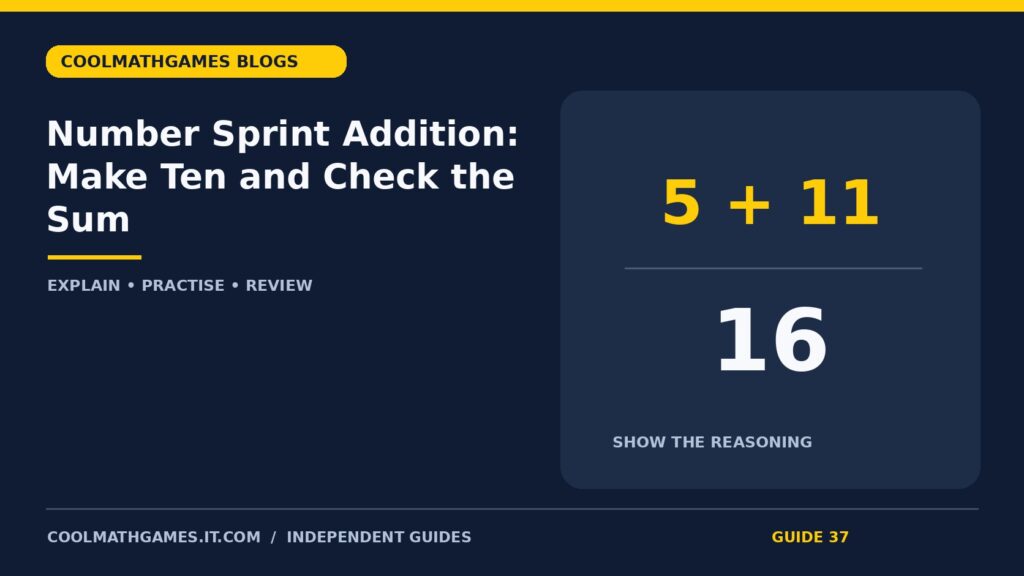
1. Calculation 1: 5 + 11
The exercise is 5 + 11. Work it out before reading the answer. These numbers sit within the operand range used by our local Number Sprint, but this is a written exercise rather than a question captured from a live round.
The answer is 16. One split is 5 + 5 + 6. The first part gives 10; adding the remaining 6 gives 16. The two parts of the second addend still total 11, so the question has not changed. The inverse check is 16 minus 5, which returns 11. You can also reverse the addends and calculate 11 plus 5. That is a check for addition, not permission to reverse every operation.
For an independent representation, show 5 and 11 using counters, equal groups or a number line appropriate to the operation. Explain why that representation gives 16. Then change one operand by one and predict how the answer changes before recalculating. Your explanation should identify the operation, not just repeat the final answer.
2. Calculation 2: 8 + 7
The exercise is 8 + 7. Work it out before reading the answer. These numbers sit within the operand range used by our local Number Sprint, but this is a written exercise rather than a question captured from a live round.
The answer is 15. One split is 8 + 2 + 5. The first part gives 10; adding the remaining 5 gives 15. The two parts of the second addend still total 7, so the question has not changed. The inverse check is 15 minus 8, which returns 7. You can also reverse the addends and calculate 7 plus 8. That is a check for addition, not permission to reverse every operation.
For an independent representation, show 8 and 7 using counters, equal groups or a number line appropriate to the operation. Explain why that representation gives 15. Then change one operand by one and predict how the answer changes before recalculating. Your explanation should identify the operation, not just repeat the final answer.
3. Calculation 3: 10 + 10
The exercise is 10 + 10. Work it out before reading the answer. These numbers sit within the operand range used by our local Number Sprint, but this is a written exercise rather than a question captured from a live round.
The answer is 20. One split is 10 + 0 + 10. The first part gives 10; adding the remaining 10 gives 20. The two parts of the second addend still total 10, so the question has not changed. The inverse check is 20 minus 10, which returns 10. You can also reverse the addends and calculate 10 plus 10. That is a check for addition, not permission to reverse every operation.
For an independent representation, show 10 and 10 using counters, equal groups or a number line appropriate to the operation. Explain why that representation gives 20. Then change one operand by one and predict how the answer changes before recalculating. Your explanation should identify the operation, not just repeat the final answer.
4. Calculation 4: 12 + 9
The exercise is 12 + 9. Work it out before reading the answer. These numbers sit within the operand range used by our local Number Sprint, but this is a written exercise rather than a question captured from a live round.
The answer is 21. One split is 12 + 0 + 9. The first part gives 12; adding the remaining 9 gives 21. The two parts of the second addend still total 9, so the question has not changed. The inverse check is 21 minus 12, which returns 9. You can also reverse the addends and calculate 9 plus 12. That is a check for addition, not permission to reverse every operation.
For an independent representation, show 12 and 9 using counters, equal groups or a number line appropriate to the operation. Explain why that representation gives 21. Then change one operand by one and predict how the answer changes before recalculating. Your explanation should identify the operation, not just repeat the final answer.
5. Calculation 5: 9 + 3
The exercise is 9 + 3. Work it out before reading the answer. These numbers sit within the operand range used by our local Number Sprint, but this is a written exercise rather than a question captured from a live round.
The answer is 12. One split is 9 + 1 + 2. The first part gives 10; adding the remaining 2 gives 12. The two parts of the second addend still total 3, so the question has not changed. The inverse check is 12 minus 9, which returns 3. You can also reverse the addends and calculate 3 plus 9. That is a check for addition, not permission to reverse every operation.
For an independent representation, show 9 and 3 using counters, equal groups or a number line appropriate to the operation. Explain why that representation gives 12. Then change one operand by one and predict how the answer changes before recalculating. Your explanation should identify the operation, not just repeat the final answer.
6. Calculation 6: 3 + 5
The exercise is 3 + 5. Work it out before reading the answer. These numbers sit within the operand range used by our local Number Sprint, but this is a written exercise rather than a question captured from a live round.
The answer is 8. One split is 3 + 5 + 0. The first part gives 8; adding the remaining 0 gives 8. The two parts of the second addend still total 5, so the question has not changed. The inverse check is 8 minus 3, which returns 5. You can also reverse the addends and calculate 5 plus 3. That is a check for addition, not permission to reverse every operation.
For an independent representation, show 3 and 5 using counters, equal groups or a number line appropriate to the operation. Explain why that representation gives 8. Then change one operand by one and predict how the answer changes before recalculating. Your explanation should identify the operation, not just repeat the final answer.
7. Calculation 7: 8 + 11
The exercise is 8 + 11. Work it out before reading the answer. These numbers sit within the operand range used by our local Number Sprint, but this is a written exercise rather than a question captured from a live round.
The answer is 19. One split is 8 + 2 + 9. The first part gives 10; adding the remaining 9 gives 19. The two parts of the second addend still total 11, so the question has not changed. The inverse check is 19 minus 8, which returns 11. You can also reverse the addends and calculate 11 plus 8. That is a check for addition, not permission to reverse every operation.
For an independent representation, show 8 and 11 using counters, equal groups or a number line appropriate to the operation. Explain why that representation gives 19. Then change one operand by one and predict how the answer changes before recalculating. Your explanation should identify the operation, not just repeat the final answer.
8. Calculation 8: 10 + 4
The exercise is 10 + 4. Work it out before reading the answer. These numbers sit within the operand range used by our local Number Sprint, but this is a written exercise rather than a question captured from a live round.
The answer is 14. One split is 10 + 0 + 4. The first part gives 10; adding the remaining 4 gives 14. The two parts of the second addend still total 4, so the question has not changed. The inverse check is 14 minus 10, which returns 4. You can also reverse the addends and calculate 4 plus 10. That is a check for addition, not permission to reverse every operation.
For an independent representation, show 10 and 4 using counters, equal groups or a number line appropriate to the operation. Explain why that representation gives 14. Then change one operand by one and predict how the answer changes before recalculating. Your explanation should identify the operation, not just repeat the final answer.
9. Calculation 9: 4 + 4
The exercise is 4 + 4. Work it out before reading the answer. These numbers sit within the operand range used by our local Number Sprint, but this is a written exercise rather than a question captured from a live round.
The answer is 8. One split is 4 + 4 + 0. The first part gives 8; adding the remaining 0 gives 8. The two parts of the second addend still total 4, so the question has not changed. The inverse check is 8 minus 4, which returns 4. You can also reverse the addends and calculate 4 plus 4. That is a check for addition, not permission to reverse every operation.
For an independent representation, show 4 and 4 using counters, equal groups or a number line appropriate to the operation. Explain why that representation gives 8. Then change one operand by one and predict how the answer changes before recalculating. Your explanation should identify the operation, not just repeat the final answer.
10. Calculation 10: 8 + 3
The exercise is 8 + 3. Work it out before reading the answer. These numbers sit within the operand range used by our local Number Sprint, but this is a written exercise rather than a question captured from a live round.
The answer is 11. One split is 8 + 2 + 1. The first part gives 10; adding the remaining 1 gives 11. The two parts of the second addend still total 3, so the question has not changed. The inverse check is 11 minus 8, which returns 3. You can also reverse the addends and calculate 3 plus 8. That is a check for addition, not permission to reverse every operation.
For an independent representation, show 8 and 3 using counters, equal groups or a number line appropriate to the operation. Explain why that representation gives 11. Then change one operand by one and predict how the answer changes before recalculating. Your explanation should identify the operation, not just repeat the final answer.
Use the guide in your next session
Read the operation sign before calculating. Then say the two parts of the split and check that they still add up to the original addend.
Begin with one observation connected to number sprint addition. After checking an example, close the answer and reconstruct the reasoning in your own words. If a step is uncertain, return to that step rather than repeating a result you cannot explain. A small, specific correction provides a clearer next aim than trying to improve every part of a game at once.
Frequently asked questions
Is Number Sprint a timed test?
The local implementation has ten questions and no countdown. Its name should not be interpreted as a claim that every learner must rush.
Which operands do these exercises use?
They use whole-number operands from one to twelve, matching the local code. Subtraction is arranged to avoid negative results.
Does one score measure general maths ability?
No. A short random round describes those answers. Review the particular operation, method and calculation instead of making a broad assessment.
More cool math games guides
- Number Sprint Subtraction: Find the Difference Clearly
- Number Sprint Multiplication: Break a Product into Parts
- Open the relevant game or guide page
Sources and scope
This is an independent, AI-assisted editorial guide. The worked examples and diagrams are original teaching material, not official game screenshots or a claim of personal live-game testing. Game interfaces can change; check the current instructions when controls or rules differ.