If you play Minesweeper on Cool Math Games, this independent guide offers practice with minesweeper subset patterns. Its exercises distinguish a proved local deduction from an estimate that depends on additional assumptions.
Two clues can say more together than either says alone. The useful comparison begins when one set of unknown neighbours is contained within another.
A practical starting point
Write the two sets and their remaining mine requirements. Subtract the smaller set from the larger only when the containment is genuine and both counts use the same confirmed information.
Containment makes the subtraction valid
Label the unknown neighbours of each clue and subtract confirmed mines from both requirements. If one unknown set is wholly contained in the other, subtract its requirement from the larger set’s requirement. The difference belongs to the cells that appear only in the larger set. Similar-looking numbers on the screen are not enough; the actual cell sets must match the relation. The exercises state these sets directly so that you can check the logic without relying on a memorised visual pattern.
A mistake to watch for
Do not memorise a row of numbers without checking the shared cells. Similar-looking patterns can have different unknown-neighbour sets at an edge or beside an already opened area.
Worked examples and practice decisions
Try each question before reading its explanation. These examples are deliberately limited to the information they state. They separate a rule or calculation from a broader judgement about a complete game.
1. Clue exercise 1: check the unknown set
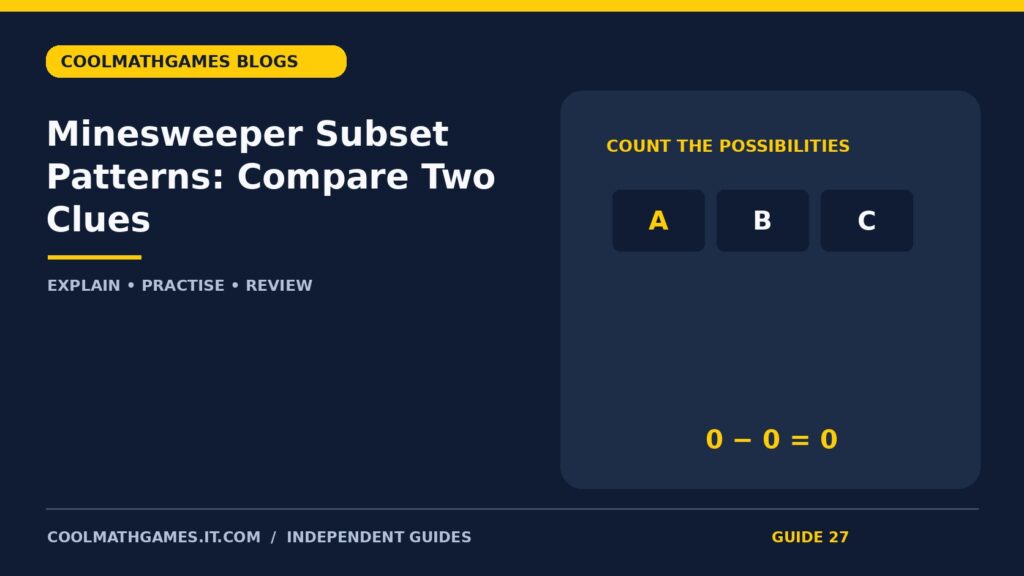
After subtracting confirmed mines, clue A requires 0 mines in the set A, B. Clue B requires 0 mines in A, B, C. The first set is entirely contained in the second. Before reading the calculation, separate the covered-cell set from any nearby square that is not part of it. All confirmed mines in this exercise are assumptions stated in the question, not guesses represented by flags.
The cells belonging only to B are C. Their remaining requirement is 0 − 0 = 0. Those extra cells are safe. This is a set subtraction, not a claim based on how close the displayed clue numbers look.
Countercheck: remove one shared cell from the supposed containment relation and ask whether the same set subtraction still applies. The displayed number difference alone does not prove the result. Draw the two sets as labelled groups, identify their overlap, and apply the conclusion only to the cells that remain after the valid subtraction.
2. Clue exercise 2: check the unknown set
After subtracting confirmed mines, clue A requires 1 mines in the set A, B, C. Clue B requires 3 mines in A, B, C, D, E. The first set is entirely contained in the second. Before reading the calculation, separate the covered-cell set from any nearby square that is not part of it. All confirmed mines in this exercise are assumptions stated in the question, not guesses represented by flags.
The cells belonging only to B are D, E. Their remaining requirement is 3 − 1 = 2. Every one of those extra cells must be a mine. This is a set subtraction, not a claim based on how close the displayed clue numbers look.
Countercheck: remove one shared cell from the supposed containment relation and ask whether the same set subtraction still applies. The displayed number difference alone does not prove the result. Draw the two sets as labelled groups, identify their overlap, and apply the conclusion only to the cells that remain after the valid subtraction.
3. Clue exercise 3: check the unknown set
After subtracting confirmed mines, clue A requires 2 mines in the set A, B, C, D. Clue B requires 2 mines in A, B, C, D, E. The first set is entirely contained in the second. Before reading the calculation, separate the covered-cell set from any nearby square that is not part of it. All confirmed mines in this exercise are assumptions stated in the question, not guesses represented by flags.
The cells belonging only to B are E. Their remaining requirement is 2 − 2 = 0. Those extra cells are safe. This is a set subtraction, not a claim based on how close the displayed clue numbers look.
Countercheck: remove one shared cell from the supposed containment relation and ask whether the same set subtraction still applies. The displayed number difference alone does not prove the result. Draw the two sets as labelled groups, identify their overlap, and apply the conclusion only to the cells that remain after the valid subtraction.
4. Clue exercise 4: check the unknown set
After subtracting confirmed mines, clue A requires 0 mines in the set A, B. Clue B requires 2 mines in A, B, C, D. The first set is entirely contained in the second. Before reading the calculation, separate the covered-cell set from any nearby square that is not part of it. All confirmed mines in this exercise are assumptions stated in the question, not guesses represented by flags.
The cells belonging only to B are C, D. Their remaining requirement is 2 − 0 = 2. Every one of those extra cells must be a mine. This is a set subtraction, not a claim based on how close the displayed clue numbers look.
Countercheck: remove one shared cell from the supposed containment relation and ask whether the same set subtraction still applies. The displayed number difference alone does not prove the result. Draw the two sets as labelled groups, identify their overlap, and apply the conclusion only to the cells that remain after the valid subtraction.
5. Clue exercise 5: check the unknown set
After subtracting confirmed mines, clue A requires 0 mines in the set A, B, C. Clue B requires 0 mines in A, B, C, D. The first set is entirely contained in the second. Before reading the calculation, separate the covered-cell set from any nearby square that is not part of it. All confirmed mines in this exercise are assumptions stated in the question, not guesses represented by flags.
The cells belonging only to B are D. Their remaining requirement is 0 − 0 = 0. Those extra cells are safe. This is a set subtraction, not a claim based on how close the displayed clue numbers look.
Countercheck: remove one shared cell from the supposed containment relation and ask whether the same set subtraction still applies. The displayed number difference alone does not prove the result. Draw the two sets as labelled groups, identify their overlap, and apply the conclusion only to the cells that remain after the valid subtraction.
6. Clue exercise 6: check the unknown set
After subtracting confirmed mines, clue A requires 0 mines in the set A, B, C, D. Clue B requires 2 mines in A, B, C, D, E, F. The first set is entirely contained in the second. Before reading the calculation, separate the covered-cell set from any nearby square that is not part of it. All confirmed mines in this exercise are assumptions stated in the question, not guesses represented by flags.
The cells belonging only to B are E, F. Their remaining requirement is 2 − 0 = 2. Every one of those extra cells must be a mine. This is a set subtraction, not a claim based on how close the displayed clue numbers look.
Countercheck: remove one shared cell from the supposed containment relation and ask whether the same set subtraction still applies. The displayed number difference alone does not prove the result. Draw the two sets as labelled groups, identify their overlap, and apply the conclusion only to the cells that remain after the valid subtraction.
7. Clue exercise 7: check the unknown set
After subtracting confirmed mines, clue A requires 0 mines in the set B, C. Clue B requires 0 mines in B, C, D. The first set is entirely contained in the second. Before reading the calculation, separate the covered-cell set from any nearby square that is not part of it. All confirmed mines in this exercise are assumptions stated in the question, not guesses represented by flags.
The cells belonging only to B are D. Their remaining requirement is 0 − 0 = 0. Those extra cells are safe. This is a set subtraction, not a claim based on how close the displayed clue numbers look.
Countercheck: remove one shared cell from the supposed containment relation and ask whether the same set subtraction still applies. The displayed number difference alone does not prove the result. Draw the two sets as labelled groups, identify their overlap, and apply the conclusion only to the cells that remain after the valid subtraction.
8. Clue exercise 8: check the unknown set
After subtracting confirmed mines, clue A requires 3 mines in the set B, C, D. Clue B requires 5 mines in B, C, D, E, F. The first set is entirely contained in the second. Before reading the calculation, separate the covered-cell set from any nearby square that is not part of it. All confirmed mines in this exercise are assumptions stated in the question, not guesses represented by flags.
The cells belonging only to B are E, F. Their remaining requirement is 5 − 3 = 2. Every one of those extra cells must be a mine. This is a set subtraction, not a claim based on how close the displayed clue numbers look.
Countercheck: remove one shared cell from the supposed containment relation and ask whether the same set subtraction still applies. The displayed number difference alone does not prove the result. Draw the two sets as labelled groups, identify their overlap, and apply the conclusion only to the cells that remain after the valid subtraction.
9. Clue exercise 9: check the unknown set
After subtracting confirmed mines, clue A requires 3 mines in the set B, C, D, E. Clue B requires 3 mines in B, C, D, E, F. The first set is entirely contained in the second. Before reading the calculation, separate the covered-cell set from any nearby square that is not part of it. All confirmed mines in this exercise are assumptions stated in the question, not guesses represented by flags.
The cells belonging only to B are F. Their remaining requirement is 3 − 3 = 0. Those extra cells are safe. This is a set subtraction, not a claim based on how close the displayed clue numbers look.
Countercheck: remove one shared cell from the supposed containment relation and ask whether the same set subtraction still applies. The displayed number difference alone does not prove the result. Draw the two sets as labelled groups, identify their overlap, and apply the conclusion only to the cells that remain after the valid subtraction.
10. Clue exercise 10: check the unknown set
After subtracting confirmed mines, clue A requires 0 mines in the set B, C. Clue B requires 2 mines in B, C, D, E. The first set is entirely contained in the second. Before reading the calculation, separate the covered-cell set from any nearby square that is not part of it. All confirmed mines in this exercise are assumptions stated in the question, not guesses represented by flags.
The cells belonging only to B are D, E. Their remaining requirement is 2 − 0 = 2. Every one of those extra cells must be a mine. This is a set subtraction, not a claim based on how close the displayed clue numbers look.
Countercheck: remove one shared cell from the supposed containment relation and ask whether the same set subtraction still applies. The displayed number difference alone does not prove the result. Draw the two sets as labelled groups, identify their overlap, and apply the conclusion only to the cells that remain after the valid subtraction.
Use the guide in your next session
Name the cells with letters, compare the sets and then return to the board. The letters are a temporary aid; the conclusion must apply to the actual cells those letters represent.
Begin with one observation connected to minesweeper subset patterns. After checking an example, close the answer and reconstruct the reasoning in your own words. If a step is uncertain, return to that step rather than repeating a result you cannot explain. A small, specific correction provides a clearer next aim than trying to improve every part of a game at once.
Frequently asked questions
Does a flag prove a mine is present?
A flag records a choice. Subtract it from a clue only when the reasoning has actually established that mine.
Are diagonal cells neighbours?
Yes. Interior clues can refer to eight adjacent cells, while edges and corners have fewer neighbours.
Does a local probability give exact full-board risk?
Only if its assumptions match all relevant information. Other clues or a known total mine count can alter the possible assignments.
More cool math games guides
- Minesweeper Beginner Guide: Read the Eight Neighbours
- Minesweeper Safe Squares: Subtract Confirmed Flags
- Open the relevant game or guide page
Sources and scope
This is an independent, AI-assisted editorial guide. The worked examples and diagrams are original teaching material, not official game screenshots or a claim of personal live-game testing. Game interfaces can change; check the current instructions when controls or rules differ.