Looking for cool math games built around short logic decisions? This guide focuses on tic-tac-toe draw strategy in our own local Tic-Tac-Toe. This site is independent of the official Coolmath Games website, and the examples use ordinary three-by-three rules.
A draw is not evidence that nothing happened. It can show that both players kept preventing direct losses. A useful review asks which choices preserved a draw and which allowed a forced defeat.
A practical starting point
The examples use a complete search of the small game tree. A listed drawing choice means that a draw can be maintained with suitable later play, not that every possible continuation will draw.
A drawing move still needs correct replies
A search result of draw says that a draw can be maintained with suitable choices; it does not make every later move safe. Review one decision at a time. Compare a drawing choice with an alternative and locate the first future threat that changes the result. This can be done without claiming that a particular human player would always find the continuation. The exercises evaluate the small legal game tree and distinguish the mathematical result from a prediction about someone’s behaviour.
A mistake to watch for
Do not confuse a move that avoids losing immediately with a move that avoids every forced loss. Some traps take more than one turn to appear. The distinction is why the examples include a search-based result.
Worked examples and practice decisions
Try each question before reading its explanation. These examples are deliberately limited to the information they state. They separate a rule or calculation from a broader judgement about a complete game.
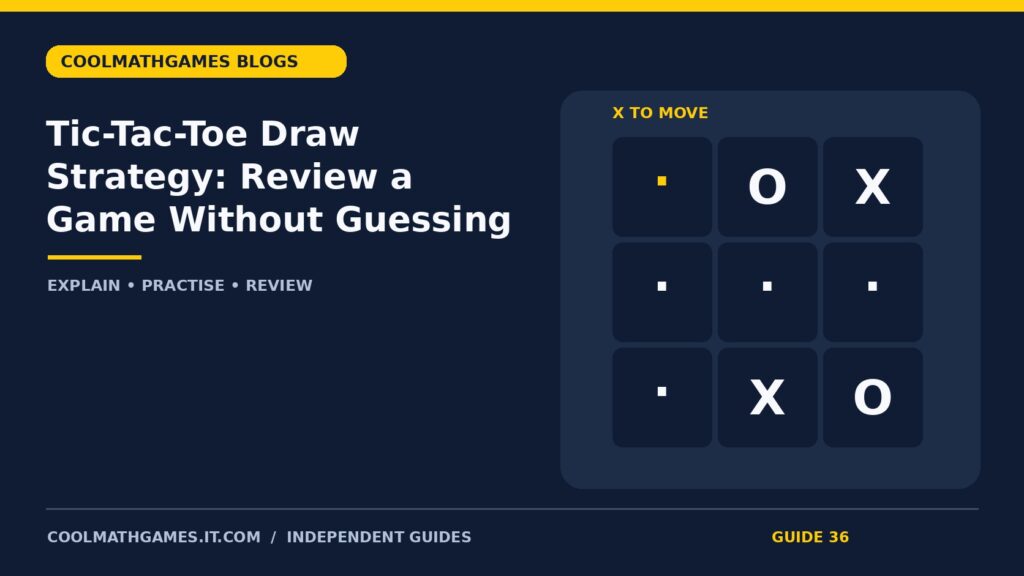
1. Position 1: X to move
| Left | Middle | Right |
|---|---|---|
| Empty | O | X |
| Empty | Empty | Empty |
| Empty | X | O |
It is X’s turn. There are 4 occupied squares and 5 empty squares. Predict a move before reading the next paragraph. Keep the board orientation fixed: top-left means the first square in the displayed table, not the square nearest to a particular player.
One checked choice is top-left. A complete search of legal continuations gives a draw with suitable later play for the side to move after this choice. The proposed move keeps the search result at a draw. That means there is a way to answer future moves without being forced to lose. It does not mean that every later move is safe, so the same full-board check is needed on the next turn.
Comparison challenge: placing X at middle-left instead has search value draw. These values assume suitable play from both sides afterwards. Sketch the alternative and find a response that explains the difference, if there is one. A move with the same result can still create a different practical question on the next turn.
2. Position 2: O to move
| Left | Middle | Right |
|---|---|---|
| Empty | X | Empty |
| O | O | X |
| X | Empty | Empty |
It is O’s turn. There are 5 occupied squares and 4 empty squares. Predict a move before reading the next paragraph. Keep the board orientation fixed: top-left means the first square in the displayed table, not the square nearest to a particular player.
One checked choice is top-right. A complete search of legal continuations gives a draw with suitable later play for the side to move after this choice. The proposed move keeps the search result at a draw. That means there is a way to answer future moves without being forced to lose. It does not mean that every later move is safe, so the same full-board check is needed on the next turn.
Comparison challenge: placing O at bottom-middle instead has search value loss. These values assume suitable play from both sides afterwards. Sketch the alternative and find a response that explains the difference, if there is one. A move with the same result can still create a different practical question on the next turn.
3. Position 3: O to move
| Left | Middle | Right |
|---|---|---|
| Empty | O | Empty |
| X | Empty | Empty |
| Empty | X | Empty |
It is O’s turn. There are 3 occupied squares and 6 empty squares. Predict a move before reading the next paragraph. Keep the board orientation fixed: top-left means the first square in the displayed table, not the square nearest to a particular player.
One checked choice is bottom-left. A complete search of legal continuations gives a draw with suitable later play for the side to move after this choice. The proposed move keeps the search result at a draw. That means there is a way to answer future moves without being forced to lose. It does not mean that every later move is safe, so the same full-board check is needed on the next turn.
Comparison challenge: placing O at centre instead has search value loss. These values assume suitable play from both sides afterwards. Sketch the alternative and find a response that explains the difference, if there is one. A move with the same result can still create a different practical question on the next turn.
4. Position 4: O to move
| Left | Middle | Right |
|---|---|---|
| Empty | Empty | Empty |
| Empty | Empty | X |
| Empty | X | O |
It is O’s turn. There are 3 occupied squares and 6 empty squares. Predict a move before reading the next paragraph. Keep the board orientation fixed: top-left means the first square in the displayed table, not the square nearest to a particular player.
One checked choice is top-middle. A complete search of legal continuations gives a draw with suitable later play for the side to move after this choice. The proposed move keeps the search result at a draw. That means there is a way to answer future moves without being forced to lose. It does not mean that every later move is safe, so the same full-board check is needed on the next turn.
Comparison challenge: placing O at centre instead has search value draw. These values assume suitable play from both sides afterwards. Sketch the alternative and find a response that explains the difference, if there is one. A move with the same result can still create a different practical question on the next turn.
5. Position 5: X to move
| Left | Middle | Right |
|---|---|---|
| O | X | X |
| Empty | Empty | Empty |
| Empty | O | Empty |
It is X’s turn. There are 4 occupied squares and 5 empty squares. Predict a move before reading the next paragraph. Keep the board orientation fixed: top-left means the first square in the displayed table, not the square nearest to a particular player.
One checked choice is bottom-left. A complete search of legal continuations gives a draw with suitable later play for the side to move after this choice. The proposed move keeps the search result at a draw. That means there is a way to answer future moves without being forced to lose. It does not mean that every later move is safe, so the same full-board check is needed on the next turn.
Comparison challenge: placing X at middle-left instead has search value loss. These values assume suitable play from both sides afterwards. Sketch the alternative and find a response that explains the difference, if there is one. A move with the same result can still create a different practical question on the next turn.
6. Position 6: O to move
| Left | Middle | Right |
|---|---|---|
| Empty | X | O |
| O | Empty | X |
| X | Empty | Empty |
It is O’s turn. There are 5 occupied squares and 4 empty squares. Predict a move before reading the next paragraph. Keep the board orientation fixed: top-left means the first square in the displayed table, not the square nearest to a particular player.
One checked choice is centre. A complete search of legal continuations gives a draw with suitable later play for the side to move after this choice. The proposed move keeps the search result at a draw. That means there is a way to answer future moves without being forced to lose. It does not mean that every later move is safe, so the same full-board check is needed on the next turn.
Comparison challenge: placing O at bottom-right instead has search value draw. These values assume suitable play from both sides afterwards. Sketch the alternative and find a response that explains the difference, if there is one. A move with the same result can still create a different practical question on the next turn.
7. Position 7: O to move
| Left | Middle | Right |
|---|---|---|
| X | Empty | Empty |
| O | Empty | X |
| Empty | Empty | Empty |
It is O’s turn. There are 3 occupied squares and 6 empty squares. Predict a move before reading the next paragraph. Keep the board orientation fixed: top-left means the first square in the displayed table, not the square nearest to a particular player.
One checked choice is top-right. A complete search of legal continuations gives a draw with suitable later play for the side to move after this choice. The proposed move keeps the search result at a draw. That means there is a way to answer future moves without being forced to lose. It does not mean that every later move is safe, so the same full-board check is needed on the next turn.
Comparison challenge: placing O at centre instead has search value loss. These values assume suitable play from both sides afterwards. Sketch the alternative and find a response that explains the difference, if there is one. A move with the same result can still create a different practical question on the next turn.
8. Position 8: O to move
| Left | Middle | Right |
|---|---|---|
| X | O | X |
| Empty | Empty | Empty |
| O | X | Empty |
It is O’s turn. There are 5 occupied squares and 4 empty squares. Predict a move before reading the next paragraph. Keep the board orientation fixed: top-left means the first square in the displayed table, not the square nearest to a particular player.
One checked choice is centre. A complete search of legal continuations gives a draw with suitable later play for the side to move after this choice. The proposed move keeps the search result at a draw. That means there is a way to answer future moves without being forced to lose. It does not mean that every later move is safe, so the same full-board check is needed on the next turn.
Comparison challenge: placing O at middle-right instead has search value draw. These values assume suitable play from both sides afterwards. Sketch the alternative and find a response that explains the difference, if there is one. A move with the same result can still create a different practical question on the next turn.
9. Position 9: O to move
| Left | Middle | Right |
|---|---|---|
| Empty | Empty | Empty |
| O | Empty | X |
| X | X | O |
It is O’s turn. There are 5 occupied squares and 4 empty squares. Predict a move before reading the next paragraph. Keep the board orientation fixed: top-left means the first square in the displayed table, not the square nearest to a particular player.
One checked choice is top-middle. A complete search of legal continuations gives a draw with suitable later play for the side to move after this choice. The proposed move keeps the search result at a draw. That means there is a way to answer future moves without being forced to lose. It does not mean that every later move is safe, so the same full-board check is needed on the next turn.
Comparison challenge: placing O at centre instead has search value draw. These values assume suitable play from both sides afterwards. Sketch the alternative and find a response that explains the difference, if there is one. A move with the same result can still create a different practical question on the next turn.
Use the guide in your next session
After a shared round, choose one turn and list the alternatives. Discuss the consequence of one different move instead of replaying the entire game from memory.
Begin with one observation connected to tic-tac-toe draw strategy. After checking an example, close the answer and reconstruct the reasoning in your own words. If a step is uncertain, return to that step rather than repeating a result you cannot explain. A small, specific correction provides a clearer next aim than trying to improve every part of a game at once.
Frequently asked questions
Which player starts?
X starts under the ordinary rules used by the local game and these reachable example positions.
Does a drawing choice force every continuation to draw?
No. It means the draw can be maintained with suitable later play. A later mistake can change the outcome.
Can two lines aimed at one square form a fork?
A fork needs two distinct immediate winning destinations. Count the squares the opponent would need to cover.
More cool math games guides
- Tic-Tac-Toe Beginner Guide: Read Every Winning Line
- Tic-Tac-Toe Blocking: Stop a Direct Threat First
- Open the relevant game or guide page
Sources and scope
This is an independent, AI-assisted editorial guide. The worked examples and diagrams are original teaching material, not official game screenshots or a claim of personal live-game testing. Game interfaces can change; check the current instructions when controls or rules differ.