Looking for cool math games that involve remembering positions? This guide focuses on shared memory match in our own local Memory Match. This site is independent of the official Coolmath Games website, and the local game is a separate implementation.
A shared puzzle can become confusing when one person chooses the cards while someone else keeps calling out answers. Agree on the purpose and the turn-taking rule before the first reveal.
A practical starting point
The site’s Memory Match is a local single-player board, so any shared routine is an informal arrangement between the people at the screen. It is not an online team mode or a saved classroom activity.
Agree on help before starting
The local browser board does not add an online multiplayer system. You can still share a device and agree on a cooperative or independent-recall activity. In a cooperative activity, a partner may describe remembered addresses. In an independent activity, unsolicited hints change what the current player is being asked to do. State the agreement before the first selection and keep it consistent. Discuss one helpful observation afterwards rather than using the move count to label either player’s memory.
A mistake to watch for
Decide whether the aim is cooperative discussion or independent recall. Those are different activities. In the second, ask before offering a clue; in the first, explain sightings in a way that everyone can follow.
Worked examples and practice decisions
Try each question before reading its explanation. These examples are deliberately limited to the information they state. They separate a rule or calculation from a broader judgement about a complete game.
1. Board record 1: connect two sightings
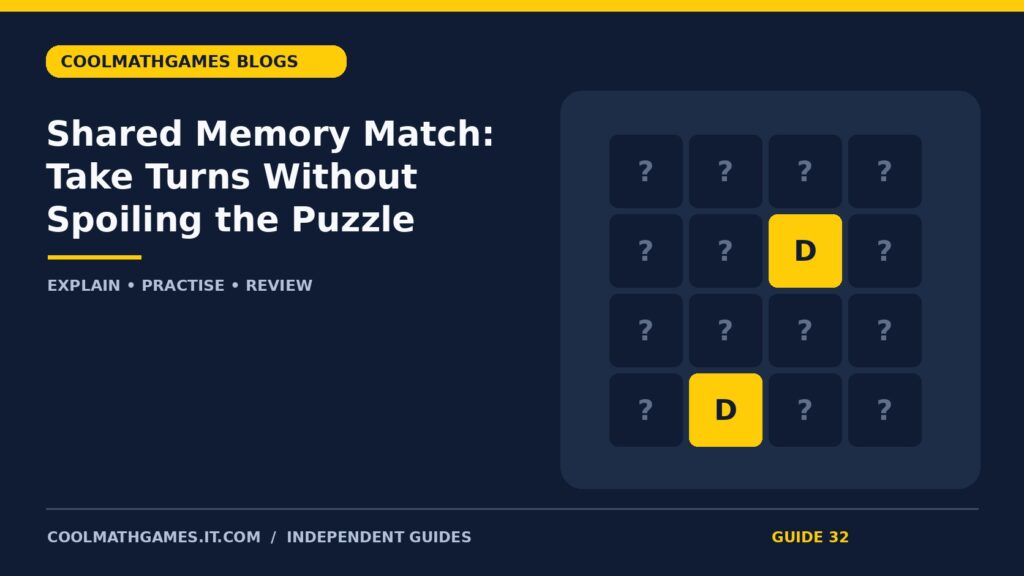
Your notes identify symbol D at row 4, column 2 and the same symbol at row 2, column 3. These are two different cards on the same illustrative board. Reconstruct the two locations on a four-by-four sketch. Do not use these positions as a prediction for the next live board: the actual game shuffles its cards.
In a cooperative routine, a partner can describe those two addresses and let the current player choose. In an independent-recall routine, the partner should wait unless help has been agreed. The underlying browser board has not become a separate team mode.
Recall check: hide the record and name both addresses of D. Then verify the addresses, not merely the symbol. If the live board is restarted, discard the old locations. For a second written exercise, describe a consistent scan through the four rows and explain how you would distinguish a card you have not seen from one whose position you have forgotten.
2. Board record 2: connect two sightings
Your notes identify symbol E at row 3, column 1 and the same symbol at row 3, column 4. These are two different cards on the same illustrative board. Reconstruct the two locations on a four-by-four sketch. Do not use these positions as a prediction for the next live board: the actual game shuffles its cards.
In a cooperative routine, a partner can describe those two addresses and let the current player choose. In an independent-recall routine, the partner should wait unless help has been agreed. The underlying browser board has not become a separate team mode.
Recall check: hide the record and name both addresses of E. Then verify the addresses, not merely the symbol. If the live board is restarted, discard the old locations. For a second written exercise, describe a consistent scan through the four rows and explain how you would distinguish a card you have not seen from one whose position you have forgotten.
3. Board record 3: connect two sightings
Your notes identify symbol H at row 4, column 3 and the same symbol at row 3, column 3. These are two different cards on the same illustrative board. Reconstruct the two locations on a four-by-four sketch. Do not use these positions as a prediction for the next live board: the actual game shuffles its cards.
In a cooperative routine, a partner can describe those two addresses and let the current player choose. In an independent-recall routine, the partner should wait unless help has been agreed. The underlying browser board has not become a separate team mode.
Recall check: hide the record and name both addresses of H. Then verify the addresses, not merely the symbol. If the live board is restarted, discard the old locations. For a second written exercise, describe a consistent scan through the four rows and explain how you would distinguish a card you have not seen from one whose position you have forgotten.
4. Board record 4: connect two sightings
Your notes identify symbol C at row 2, column 1 and the same symbol at row 1, column 2. These are two different cards on the same illustrative board. Reconstruct the two locations on a four-by-four sketch. Do not use these positions as a prediction for the next live board: the actual game shuffles its cards.
In a cooperative routine, a partner can describe those two addresses and let the current player choose. In an independent-recall routine, the partner should wait unless help has been agreed. The underlying browser board has not become a separate team mode.
Recall check: hide the record and name both addresses of C. Then verify the addresses, not merely the symbol. If the live board is restarted, discard the old locations. For a second written exercise, describe a consistent scan through the four rows and explain how you would distinguish a card you have not seen from one whose position you have forgotten.
5. Board record 5: connect two sightings
Your notes identify symbol A at row 3, column 4 and the same symbol at row 1, column 4. These are two different cards on the same illustrative board. Reconstruct the two locations on a four-by-four sketch. Do not use these positions as a prediction for the next live board: the actual game shuffles its cards.
In a cooperative routine, a partner can describe those two addresses and let the current player choose. In an independent-recall routine, the partner should wait unless help has been agreed. The underlying browser board has not become a separate team mode.
Recall check: hide the record and name both addresses of A. Then verify the addresses, not merely the symbol. If the live board is restarted, discard the old locations. For a second written exercise, describe a consistent scan through the four rows and explain how you would distinguish a card you have not seen from one whose position you have forgotten.
6. Board record 6: connect two sightings
Your notes identify symbol D at row 1, column 2 and the same symbol at row 3, column 4. These are two different cards on the same illustrative board. Reconstruct the two locations on a four-by-four sketch. Do not use these positions as a prediction for the next live board: the actual game shuffles its cards.
In a cooperative routine, a partner can describe those two addresses and let the current player choose. In an independent-recall routine, the partner should wait unless help has been agreed. The underlying browser board has not become a separate team mode.
Recall check: hide the record and name both addresses of D. Then verify the addresses, not merely the symbol. If the live board is restarted, discard the old locations. For a second written exercise, describe a consistent scan through the four rows and explain how you would distinguish a card you have not seen from one whose position you have forgotten.
7. Board record 7: connect two sightings
Your notes identify symbol A at row 3, column 1 and the same symbol at row 1, column 2. These are two different cards on the same illustrative board. Reconstruct the two locations on a four-by-four sketch. Do not use these positions as a prediction for the next live board: the actual game shuffles its cards.
In a cooperative routine, a partner can describe those two addresses and let the current player choose. In an independent-recall routine, the partner should wait unless help has been agreed. The underlying browser board has not become a separate team mode.
Recall check: hide the record and name both addresses of A. Then verify the addresses, not merely the symbol. If the live board is restarted, discard the old locations. For a second written exercise, describe a consistent scan through the four rows and explain how you would distinguish a card you have not seen from one whose position you have forgotten.
8. Board record 8: connect two sightings
Your notes identify symbol E at row 2, column 1 and the same symbol at row 1, column 2. These are two different cards on the same illustrative board. Reconstruct the two locations on a four-by-four sketch. Do not use these positions as a prediction for the next live board: the actual game shuffles its cards.
In a cooperative routine, a partner can describe those two addresses and let the current player choose. In an independent-recall routine, the partner should wait unless help has been agreed. The underlying browser board has not become a separate team mode.
Recall check: hide the record and name both addresses of E. Then verify the addresses, not merely the symbol. If the live board is restarted, discard the old locations. For a second written exercise, describe a consistent scan through the four rows and explain how you would distinguish a card you have not seen from one whose position you have forgotten.
9. Board record 9: connect two sightings
Your notes identify symbol C at row 1, column 1 and the same symbol at row 4, column 3. These are two different cards on the same illustrative board. Reconstruct the two locations on a four-by-four sketch. Do not use these positions as a prediction for the next live board: the actual game shuffles its cards.
In a cooperative routine, a partner can describe those two addresses and let the current player choose. In an independent-recall routine, the partner should wait unless help has been agreed. The underlying browser board has not become a separate team mode.
Recall check: hide the record and name both addresses of C. Then verify the addresses, not merely the symbol. If the live board is restarted, discard the old locations. For a second written exercise, describe a consistent scan through the four rows and explain how you would distinguish a card you have not seen from one whose position you have forgotten.
10. Board record 10: connect two sightings
Your notes identify symbol D at row 3, column 2 and the same symbol at row 1, column 4. These are two different cards on the same illustrative board. Reconstruct the two locations on a four-by-four sketch. Do not use these positions as a prediction for the next live board: the actual game shuffles its cards.
In a cooperative routine, a partner can describe those two addresses and let the current player choose. In an independent-recall routine, the partner should wait unless help has been agreed. The underlying browser board has not become a separate team mode.
Recall check: hide the record and name both addresses of D. Then verify the addresses, not merely the symbol. If the live board is restarted, discard the old locations. For a second written exercise, describe a consistent scan through the four rows and explain how you would distinguish a card you have not seen from one whose position you have forgotten.
Use the guide in your next session
Use a short round and discuss one useful observation at the end. You can share a device without inventing rankings, penalties or a claim that the game measures a learner’s ability.
Begin with one observation connected to shared memory match. After checking an example, close the answer and reconstruct the reasoning in your own words. If a step is uncertain, return to that step rather than repeating a result you cannot explain. A small, specific correction provides a clearer next aim than trying to improve every part of a game at once.
Frequently asked questions
Does the written layout predict the live board?
No. The live board shuffles. The coordinates in these examples belong only to their illustrative records.
When does a move count increase?
In this local implementation, a second different card completes a move. The first selection alone is not a completed pair selection.
Is a shared-device activity an online team mode?
No. It is an agreement between people sharing the local board, with no separate online multiplayer feature implied.
More cool math games guides
- Memory Match Guide: Rules and a Clear First Board
- Memory Match Move Counts: Measure a Round Fairly
- Open the relevant game or guide page
Sources and scope
This is an independent, AI-assisted editorial guide. The worked examples and diagrams are original teaching material, not official game screenshots or a claim of personal live-game testing. Game interfaces can change; check the current instructions when controls or rules differ.