For readers playing Sudoku on Cool Math Games, this independent guide focuses on sudoku mistake review. The examples teach stated local constraints, rather than presenting complete puzzles with proved unique solutions.
A wrong entry can spread through a puzzle because later deductions depend on it. Reviewing the reason for a placement is often more useful than staring at the final conflict.
A practical starting point
Work backwards from a contradiction and ask which earlier number lacked a complete justification. Distinguish an incorrect final digit from an inaccurate candidate note; they call for different corrections.
Review the justification before rebuilding the puzzle
When a contradiction appears, identify what kind of statement failed. A repeated final digit is different from a missing candidate note, and an unsupported guess is different from an incorrectly applied rule. Return to the last deduction you can explain. Reconstruct its missing-digit set and the exclusions used at the target cell. Do not replace one unproved entry with another merely because the replacement avoids an immediate duplicate. The goal is a justified placement, not a temporarily neat-looking unit.
A mistake to watch for
A repeated number is an obvious warning, but a neat-looking unit can still contain an unsupported choice. The absence of an immediate conflict is not proof that a move was forced.
Worked examples and practice decisions
Try each question before reading its explanation. These examples are deliberately limited to the information they state. They separate a rule or calculation from a broader judgement about a complete game.
1. Candidate exercise 1: identify the forced digit
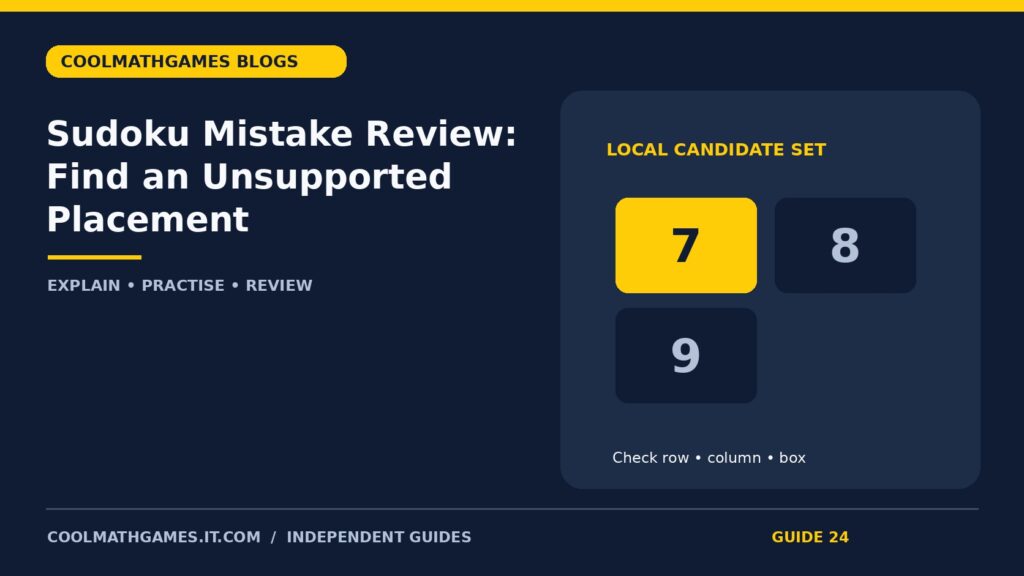
A row already contains [1, 2, 3, 4, 5, 6] and is missing [7, 8, 9]. For the target empty cell, its crossing column or box excludes [8, 9]. These exclusions are explicitly supplied for this local exercise. Write the missing-digit set before selecting a final number. The order of the numbers in a set is not important; whether a candidate belongs to the set is what matters.
Intersecting the row’s missing digits with the crossing constraints leaves only 7. The candidate set is therefore {7}. This is a naked single for the target cell, provided the stated exclusions are correct. A proposed entry of 8 must be checked against the same constraints. Being absent from a row is not enough if the column or box rules it out.
Countercheck: the target digit 7 is one member of the stated missing set [7, 8, 9]. Choose another member and identify why it cannot replace the target under the supplied conditions. If you remove one of those conditions, reconsider whether the placement is still forced. This tests dependence on the evidence rather than on the appearance of the answer.
2. Candidate exercise 2: identify the forced digit
A row already contains [3, 4, 6, 7, 9] and is missing [1, 2, 5, 8]. For the target empty cell, its crossing column or box excludes [2, 5, 8]. These exclusions are explicitly supplied for this local exercise. Write the missing-digit set before selecting a final number. The order of the numbers in a set is not important; whether a candidate belongs to the set is what matters.
Intersecting the row’s missing digits with the crossing constraints leaves only 1. The candidate set is therefore {1}. This is a naked single for the target cell, provided the stated exclusions are correct. A proposed entry of 2 must be checked against the same constraints. Being absent from a row is not enough if the column or box rules it out.
Countercheck: the target digit 1 is one member of the stated missing set [1, 2, 5, 8]. Choose another member and identify why it cannot replace the target under the supplied conditions. If you remove one of those conditions, reconsider whether the placement is still forced. This tests dependence on the evidence rather than on the appearance of the answer.
3. Candidate exercise 3: identify the forced digit
A row already contains [1, 2, 4, 5, 7, 9] and is missing [3, 6, 8]. For the target empty cell, its crossing column or box excludes [3, 6]. These exclusions are explicitly supplied for this local exercise. Write the missing-digit set before selecting a final number. The order of the numbers in a set is not important; whether a candidate belongs to the set is what matters.
Intersecting the row’s missing digits with the crossing constraints leaves only 8. The candidate set is therefore {8}. This is a naked single for the target cell, provided the stated exclusions are correct. A proposed entry of 3 must be checked against the same constraints. Being absent from a row is not enough if the column or box rules it out.
Countercheck: the target digit 8 is one member of the stated missing set [3, 6, 8]. Choose another member and identify why it cannot replace the target under the supplied conditions. If you remove one of those conditions, reconsider whether the placement is still forced. This tests dependence on the evidence rather than on the appearance of the answer.
4. Candidate exercise 4: identify the forced digit
A row already contains [1, 2, 6, 7, 8] and is missing [3, 4, 5, 9]. For the target empty cell, its crossing column or box excludes [3, 4, 9]. These exclusions are explicitly supplied for this local exercise. Write the missing-digit set before selecting a final number. The order of the numbers in a set is not important; whether a candidate belongs to the set is what matters.
Intersecting the row’s missing digits with the crossing constraints leaves only 5. The candidate set is therefore {5}. This is a naked single for the target cell, provided the stated exclusions are correct. A proposed entry of 3 must be checked against the same constraints. Being absent from a row is not enough if the column or box rules it out.
Countercheck: the target digit 5 is one member of the stated missing set [3, 4, 5, 9]. Choose another member and identify why it cannot replace the target under the supplied conditions. If you remove one of those conditions, reconsider whether the placement is still forced. This tests dependence on the evidence rather than on the appearance of the answer.
5. Candidate exercise 5: identify the forced digit
A row already contains [1, 2, 3, 5, 6, 9] and is missing [4, 7, 8]. For the target empty cell, its crossing column or box excludes [4, 8]. These exclusions are explicitly supplied for this local exercise. Write the missing-digit set before selecting a final number. The order of the numbers in a set is not important; whether a candidate belongs to the set is what matters.
Intersecting the row’s missing digits with the crossing constraints leaves only 7. The candidate set is therefore {7}. This is a naked single for the target cell, provided the stated exclusions are correct. A proposed entry of 4 must be checked against the same constraints. Being absent from a row is not enough if the column or box rules it out.
Countercheck: the target digit 7 is one member of the stated missing set [4, 7, 8]. Choose another member and identify why it cannot replace the target under the supplied conditions. If you remove one of those conditions, reconsider whether the placement is still forced. This tests dependence on the evidence rather than on the appearance of the answer.
6. Candidate exercise 6: identify the forced digit
A row already contains [2, 3, 4, 7, 9] and is missing [1, 5, 6, 8]. For the target empty cell, its crossing column or box excludes [5, 6, 8]. These exclusions are explicitly supplied for this local exercise. Write the missing-digit set before selecting a final number. The order of the numbers in a set is not important; whether a candidate belongs to the set is what matters.
Intersecting the row’s missing digits with the crossing constraints leaves only 1. The candidate set is therefore {1}. This is a naked single for the target cell, provided the stated exclusions are correct. A proposed entry of 5 must be checked against the same constraints. Being absent from a row is not enough if the column or box rules it out.
Countercheck: the target digit 1 is one member of the stated missing set [1, 5, 6, 8]. Choose another member and identify why it cannot replace the target under the supplied conditions. If you remove one of those conditions, reconsider whether the placement is still forced. This tests dependence on the evidence rather than on the appearance of the answer.
7. Candidate exercise 7: identify the forced digit
A row already contains [1, 3, 4, 6, 7, 9] and is missing [2, 5, 8]. For the target empty cell, its crossing column or box excludes [5, 8]. These exclusions are explicitly supplied for this local exercise. Write the missing-digit set before selecting a final number. The order of the numbers in a set is not important; whether a candidate belongs to the set is what matters.
Intersecting the row’s missing digits with the crossing constraints leaves only 2. The candidate set is therefore {2}. This is a naked single for the target cell, provided the stated exclusions are correct. A proposed entry of 5 must be checked against the same constraints. Being absent from a row is not enough if the column or box rules it out.
Countercheck: the target digit 2 is one member of the stated missing set [2, 5, 8]. Choose another member and identify why it cannot replace the target under the supplied conditions. If you remove one of those conditions, reconsider whether the placement is still forced. This tests dependence on the evidence rather than on the appearance of the answer.
8. Candidate exercise 8: identify the forced digit
A row already contains [4, 5, 6, 7, 9] and is missing [1, 2, 3, 8]. For the target empty cell, its crossing column or box excludes [1, 2, 8]. These exclusions are explicitly supplied for this local exercise. Write the missing-digit set before selecting a final number. The order of the numbers in a set is not important; whether a candidate belongs to the set is what matters.
Intersecting the row’s missing digits with the crossing constraints leaves only 3. The candidate set is therefore {3}. This is a naked single for the target cell, provided the stated exclusions are correct. A proposed entry of 1 must be checked against the same constraints. Being absent from a row is not enough if the column or box rules it out.
Countercheck: the target digit 3 is one member of the stated missing set [1, 2, 3, 8]. Choose another member and identify why it cannot replace the target under the supplied conditions. If you remove one of those conditions, reconsider whether the placement is still forced. This tests dependence on the evidence rather than on the appearance of the answer.
Use the guide in your next session
Keep a short trail for difficult deductions: missing digits, checked exclusions and the resulting candidate set. When a problem appears, that trail gives you something concrete to review.
Begin with one observation connected to sudoku mistake review. After checking an example, close the answer and reconstruct the reasoning in your own words. If a step is uncertain, return to that step rather than repeating a result you cannot explain. A small, specific correction provides a clearer next aim than trying to improve every part of a game at once.
Frequently asked questions
Are these complete Sudoku puzzles?
No. They are local constraint exercises with explicitly supplied exclusions. They do not establish the uniqueness of a complete grid.
Can a partial note prove a hidden single?
Not merely by omitting a digit elsewhere. A hidden-single claim needs the other locations to have been ruled out, not simply left unrecorded.
What should I check before entering a digit?
Check the cell’s row, column and box, and identify the constraint that removes every alternative candidate.
More cool math games guides
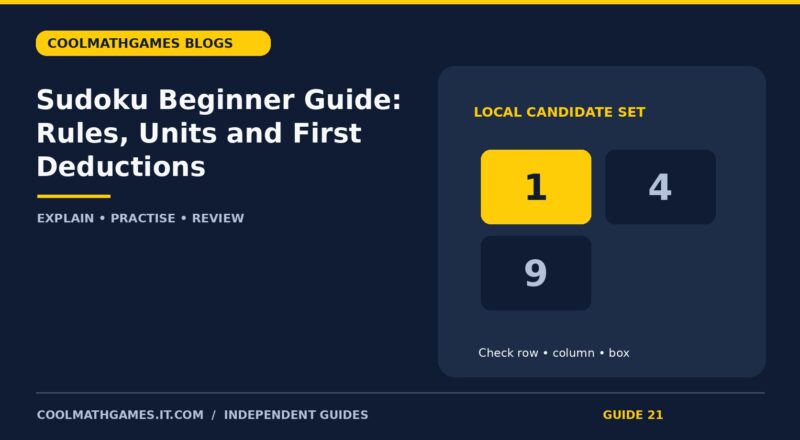
- Sudoku Beginner Guide: Rules, Units and First Deductions
- Sudoku Singles: Tell a Naked Single from a Hidden Single
- Open the relevant game or guide page
Sources and scope
This is an independent, AI-assisted editorial guide. The worked examples and diagrams are original teaching material, not official game screenshots or a claim of personal live-game testing. Game interfaces can change; check the current instructions when controls or rules differ.